Section 1 — The Missing Layer in Regulated Settlement Infrastructure
1.1 The Structural Problem with Enterprise Settlement
Global enterprises move trillions of dollars of economic value each year. Yet despite decades of technological progress, settlement remains slow, fragmented, opaque, and operationally risky.
Telecommunications operators wait weeks to reconcile roaming charges. Supply-chain counterparties rely on manual audits and dispute resolution. Carbon and environmental markets struggle with trust and verification. Highly regulated data exchanges in healthcare and critical infrastructure remain siloed due to compliance risk rather than technical capability.
These failures are not marginal inefficiencies — they are structural consequences of how settlement infrastructure is designed.
Traditional financial rails were never built for programmable, cross-border, machine-to-machine economic activity. They operate on batch cycles, depend on intermediaries, and externalise compliance, reconciliation, and audit into downstream operational processes. As transaction volume and regulatory complexity increase, risk, cost, and latency scale non-linearly.
Incremental optimisation has not solved this problem. It has merely increased the number of intermediaries involved.
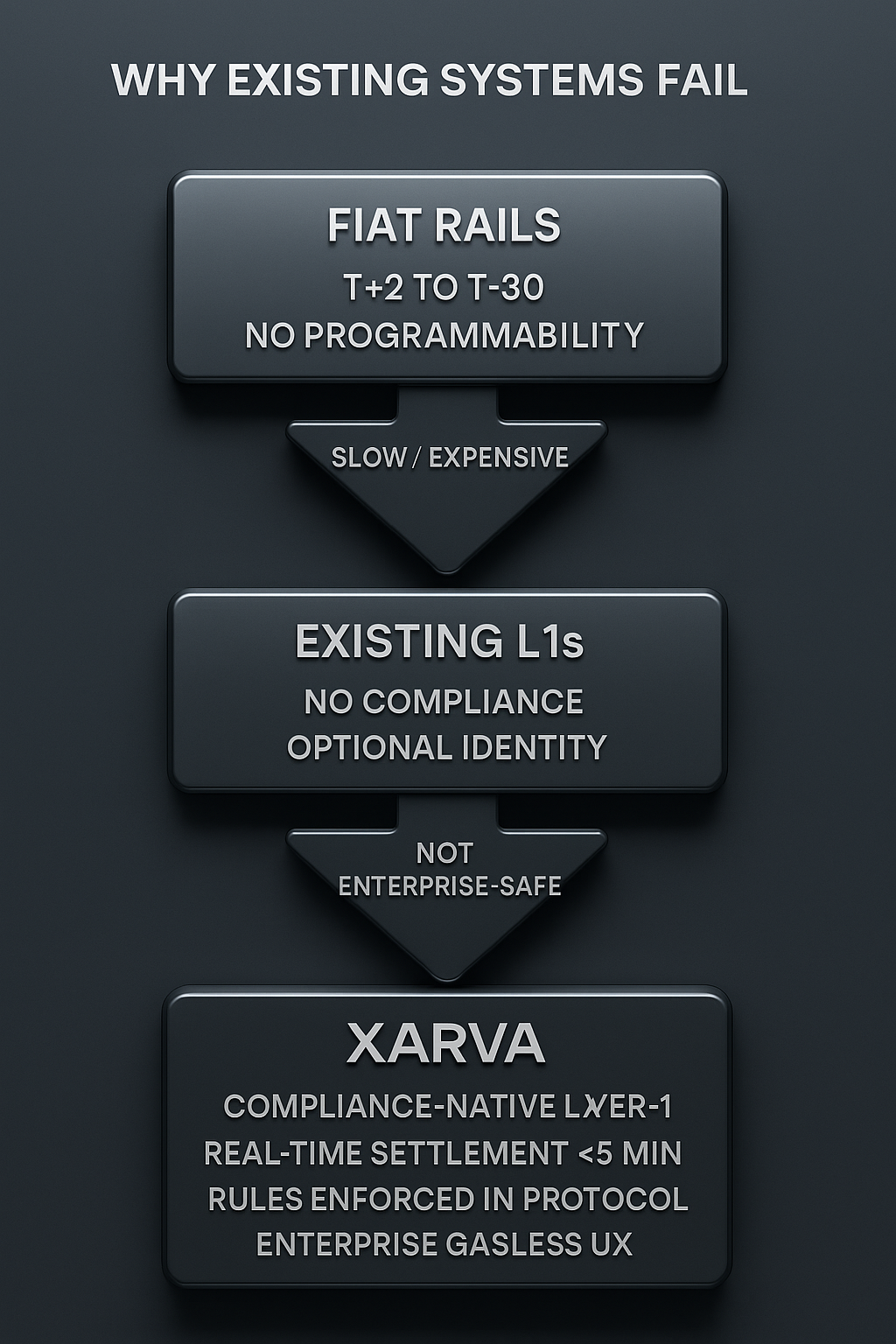
1.2 Why Existing Blockchains Do Not Solve Enterprise Settlement
Public blockchains introduced programmability and speed, but they were not designed for regulated enterprise environments.
Most blockchain systems treat identity as optional, jurisdiction as external, and compliance as an afterthought. Regulatory controls are bolted on at the application layer, enforced post-facto, or delegated to off-chain service providers. As a result, enterprises cannot rely on blockchain execution outcomes as regulator-verifiable settlement events.
This creates a false trade-off:
- Legacy systems prioritise compliance and finality at the expense of speed.
- Blockchains prioritise speed at the expense of compliance.
- Enterprises operating in regulated industries cannot accept this trade-off.
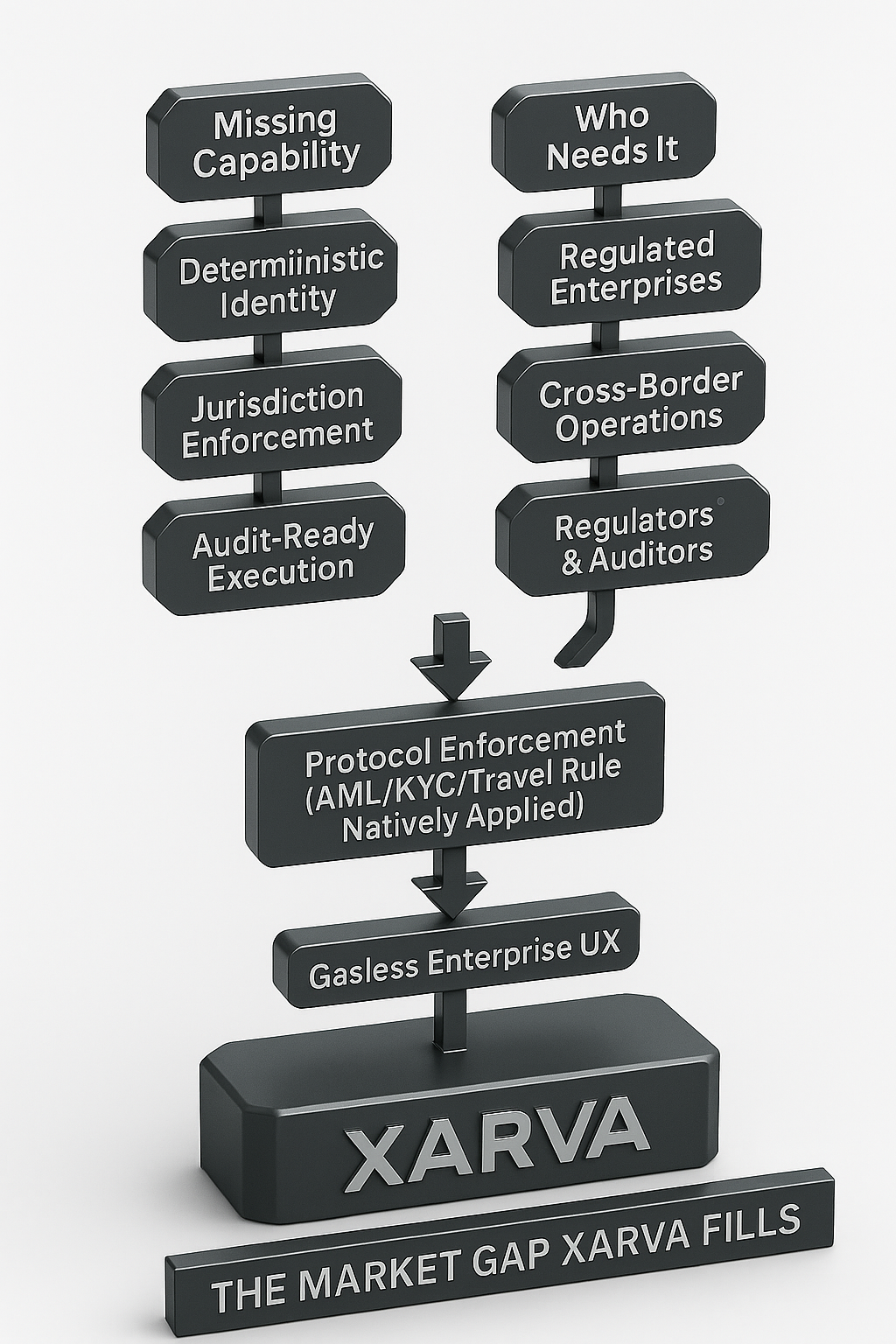
1.3 Xarva’s Core Thesis: Settlement Must Enforce Obligations, Not Just Move Value
Enterprises do not fail because payments are slow. They fail because settlement is uncertain.
Fiat rails and stablecoins focus on transferring value after the fact. Commercial terms, jurisdictional constraints, identity requirements, and policy validation are handled outside the settlement layer. Compliance checks occur before or after execution, reconciliation is manual, and disputes are resolved operationally.
Stablecoins improve transfer speed but do not change this structure. Obligations remain off-chain. Compliance remains external. Reconciliation remains post-facto.
Xarva introduces a fundamentally different approach.
Xarva is a compliance-native, enterprise-grade Layer-1 settlement network where obligations are defined and validated before execution, not reconciled afterward. Identity, jurisdiction, and policy constraints are enforced at protocol level. Execution and settlement are atomic. Audit trails are generated deterministically in real time.
Settlement becomes infrastructure — not an operational liability. The architectural, economic, and governance mechanisms that enable deterministic settlement are detailed in Sections 3, 5, and 7 respectively.
1.4 A Modular Layer-1 Built for Regulated Scale
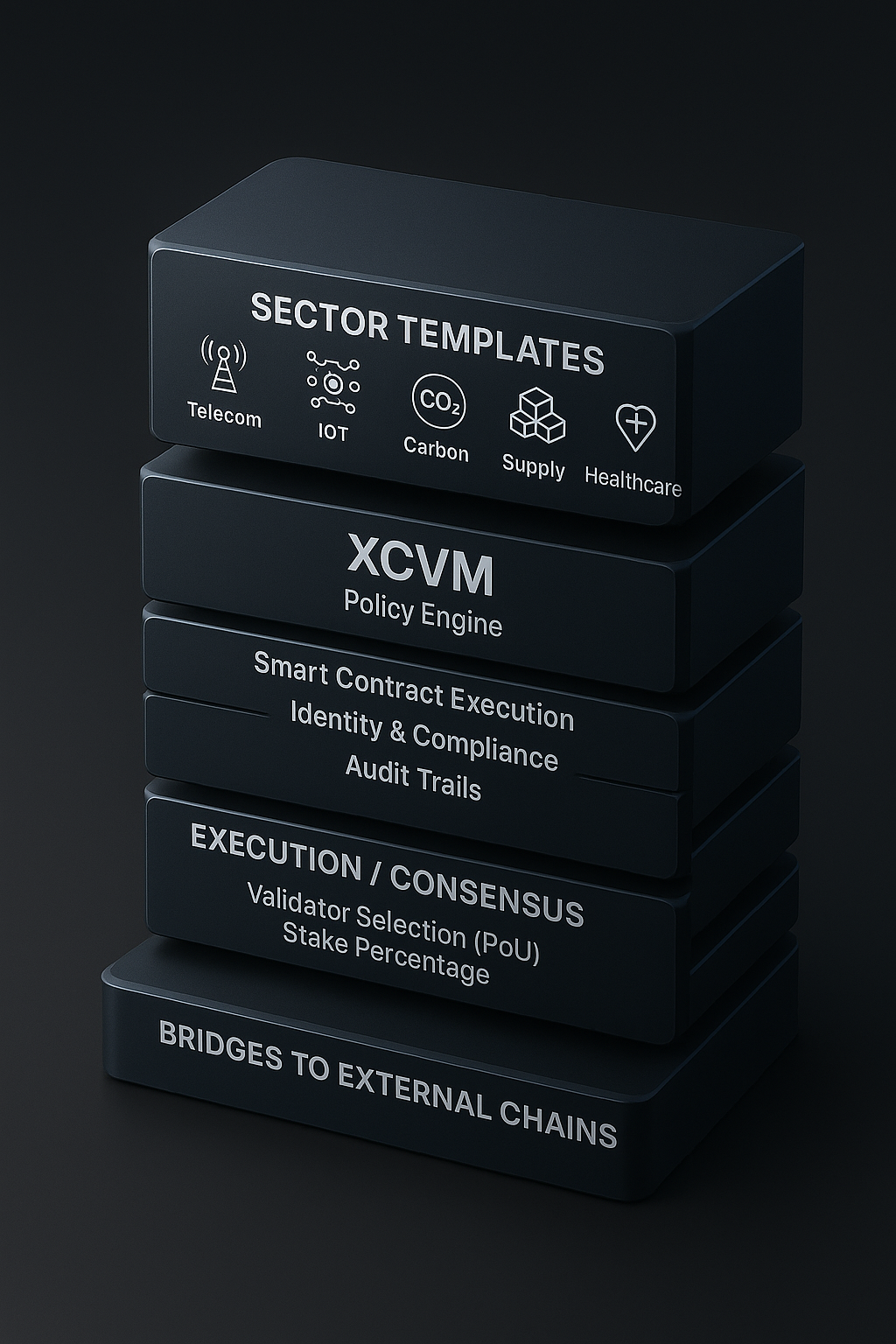
Xarva is modular by design. Execution, data availability, interoperability, and settlement are independently scalable. This separation functions as a risk-containment mechanism, preventing regulatory or operational issues in one layer from propagating across the system.
At the core of Xarva is the Xarva Compliance Virtual Machine (XCVM) — a compliance-native execution environment that deterministically enforces identity, jurisdictional policy, auditability, and settlement rules before transactions are finalised.
This architecture allows Xarva to scale global throughput without compromising determinism, security, or regulatory guarantees.
1.5 From Intent to Finality: Atomic Enterprise Settlement
Traditional settlement systems separate intent, validation, execution, and reconciliation into asynchronous steps handled by different entities. This fragmentation creates disputes, SLA breaches, and regulatory exposure.
Xarva collapses this lifecycle into a single atomic flow.
Obligations are defined, validated, executed, and settled within one deterministic pipeline. There is no post-facto reconciliation because settlement itself is the authoritative record.
1.6 Proof-of-Utility: Aligning Consensus with Real Economic Activity
Xarva introduces Proof-of-Utility (PoU) — a consensus mechanism that aligns validator rewards with verified enterprise settlement activity rather than speculative throughput.
Validators are rewarded based on:
- Settlement correctness
- Compliance enforcement accuracy
- Verified economic utility
- This ensures that network security and economic incentives scale with real-world adoption, not artificial activity.
1.7 Why Enterprises Choose Xarva Over Fiat Rails or Stablecoins
Enterprises adopt Xarva not to move money faster, but to eliminate settlement risk.
With Xarva:
- Obligations are settled, not merely paid
- Compliance is enforced, not audited later
- Identity and jurisdiction are deterministic
- Auditability is native and real-time
- Reconciliation is eliminated entirely
This transforms settlement from an operational burden into deterministic infrastructure, enabling enterprises to scale regulated economic activity with confidence, certainty, and materially lower risk. The sections that follow examine how this settlement model is realised architecturally (Section 3), operationally (Section 5), and institutionally through governance and risk controls (Section 7).
Figures 1.7–1.11 These diagrams further illustrate how Xarva reallocates settlement risk from operations to protocol-level enforcement, distinguishing settlement infrastructure from currency rails.
Section 2 — Market Forces Driving Compliance-Native Settlement
2.1 The Shift from Payments to Obligations
Global markets are undergoing a structural transition. Economic activity is no longer defined primarily by one-off payments, but by ongoing, rule-bound obligations.
Telecom roaming agreements, usage-based cloud billing, cross-border supply chains, carbon credit issuance, healthcare data access, and regulated digital services all generate obligations that are conditional, jurisdiction-dependent, and continuously reconciled.
Traditional payment systems were not designed for this reality. They move value after the fact, leaving enterprises to reconcile obligations manually across contracts, invoices, policy systems, and regulators.
As a result, enterprises face increasing exposure to:
- Disputes and delayed settlement
- Compliance breaches due to inconsistent enforcement
- Rising operational cost as volume scales
- Inability to automate regulated activity end-to-end
- This is not a tooling problem. It is an infrastructure mismatch.
2.2 Regulation as a Scaling Constraint, Not a Feature
In regulated industries, growth is constrained not by demand, but by compliance throughput.
Every new market, jurisdiction, or counterparty introduces additional policy requirements: identity checks, jurisdictional rules, reporting obligations, audit trails, and dispute resolution mechanisms. These are typically enforced through fragmented off-chain systems, human review, and post-facto audits.
As scale increases, enterprises are forced to choose between:
- Slowing growth to maintain compliance
- Accepting increased regulatory and operational risk
- Neither option is sustainable.
- This creates a clear market requirement: settlement infrastructure that scales compliance deterministically, not operationally.
2.3 Why Existing Solutions Fail to Unlock Enterprise Adoption
Several categories of solutions attempt to address this gap, but all fail structurally:
Fiat payment rails Optimised for transfers, not obligation enforcement. Compliance and reconciliation remain external and manual.
Stablecoins Improve speed, but inherit the same structural limitations as fiat rails. Obligations remain off-chain, compliance remains fragmented, and auditability is indirect.
Application-layer compliance platforms Bolt compliance onto execution rather than embedding it. Enforcement is probabilistic and difficult to defend under regulatory scrutiny.
General-purpose blockchains Optimised for throughput and programmability, but lack native identity, jurisdictional enforcement, and audit determinism required by enterprises.
None of these systems allow enterprises to treat settlement itself as a regulator-verifiable control surface.
2.4 Xarva’s Adoption Thesis: Infrastructure, Not Integration
Enterprises do not adopt new settlement infrastructure because it is novel. They adopt it because it reduces risk, cost, and operational burden.
Xarva is positioned as settlement infrastructure, not a payment product or integration layer.
Enterprises adopt Xarva when:
- Settlement risk exceeds acceptable thresholds
- Reconciliation cost becomes non-linear with growth
- Regulatory exposure limits expansion
- Existing systems cannot automate compliance end-to-end
Xarva does not require enterprises to replace internal systems. It replaces the weakest link in their stack: post-facto settlement and reconciliation.
2.5 Industry Entry Points and Early Demand Signals
Xarva’s design aligns with industries where:
- Obligations are frequent and usage-based
- Compliance requirements are explicit and auditable
- Settlement delays create material financial exposure
Examples include:
- Telecommunications roaming and inter-carrier settlement
- Cross-border supply chain finance
- Carbon and environmental markets
- Regulated data exchange (healthcare, critical infrastructure)
- Machine-to-machine economic activity
- These markets share a common trait: settlement certainty is more valuable than transfer speed.
2.6 Why XRV Is Required for Enterprise Usage
XRV is not a speculative asset layered on top of Xarva. It is the native settlement and enforcement token required to operate the network.
Enterprises use XRV because:
- Protocol fees are tied directly to settlement execution
- Compliance enforcement and validation consume network resources
- Validator incentives must align with real economic activity
- Deterministic settlement requires native economic finality
XRV functions as:
- A settlement fee mechanism
- A validator incentive instrument
- A security and abuse-prevention layer
- An alignment mechanism between enterprise usage and network sustainability
- Enterprises do not hold XRV to speculate. They acquire it to settle obligations deterministically.
2.7 Adoption Flywheel: From Risk Reduction to Network Effects
As enterprises adopt Xarva:
- Settlement risk is reduced
- Operational cost declines
- Compliance becomes deterministic
- Audit defensibility improves
- This increases confidence to onboard additional counterparties and jurisdictions, driving further usage.
Validator incentives scale with verified settlement activity, reinforcing network security and performance. Over time, this creates a usage-driven adoption flywheel, not a speculative growth loop.
Section 3 — Architecture & Compliance Enforcement
3.1 Why Compliance Must Precede Execution
In regulated environments, compliance is not an outcome — it is a precondition.
Most existing systems treat compliance as a post-execution process: transactions occur first, followed by audits, reconciliations, and regulatory checks. This model introduces ambiguity, dispute risk, and delayed enforcement.
Xarva inverts this structure.
On Xarva, no transaction is executed unless compliance conditions are satisfied beforehand. Identity validation, jurisdictional rules, policy constraints, and audit requirements are enforced deterministically prior to execution and finality.
This shift — from post-facto validation to pre-execution enforcement — is the foundation of Xarva’s architecture. This architectural principle underpins the settlement pipeline described in Section 5 and the regulatory alignment model detailed in Appendix B.
3.2 The Xarva Compliance Virtual Machine (XCVM)
At the core of the Xarva network is the Xarva Compliance Virtual Machine (XCVM).
XCVM is not a general-purpose execution engine with compliance layered on top. It is a compliance-native execution environment designed specifically for regulated settlement.
XCVM enforces:
- Identity requirements
- Jurisdictional constraints
- Policy and contract rules
- Audit and reporting logic
- These checks are evaluated before transaction execution, not after.
As a result:
- Invalid or non-compliant transactions cannot enter the execution path
- Compliance outcomes are deterministic and reproducible
- Audit trails are generated natively at execution time
- This produces outcomes that regulators and enterprises can independently verify without reliance on external systems.
3.3 Modular Architecture as a Risk Containment Strategy
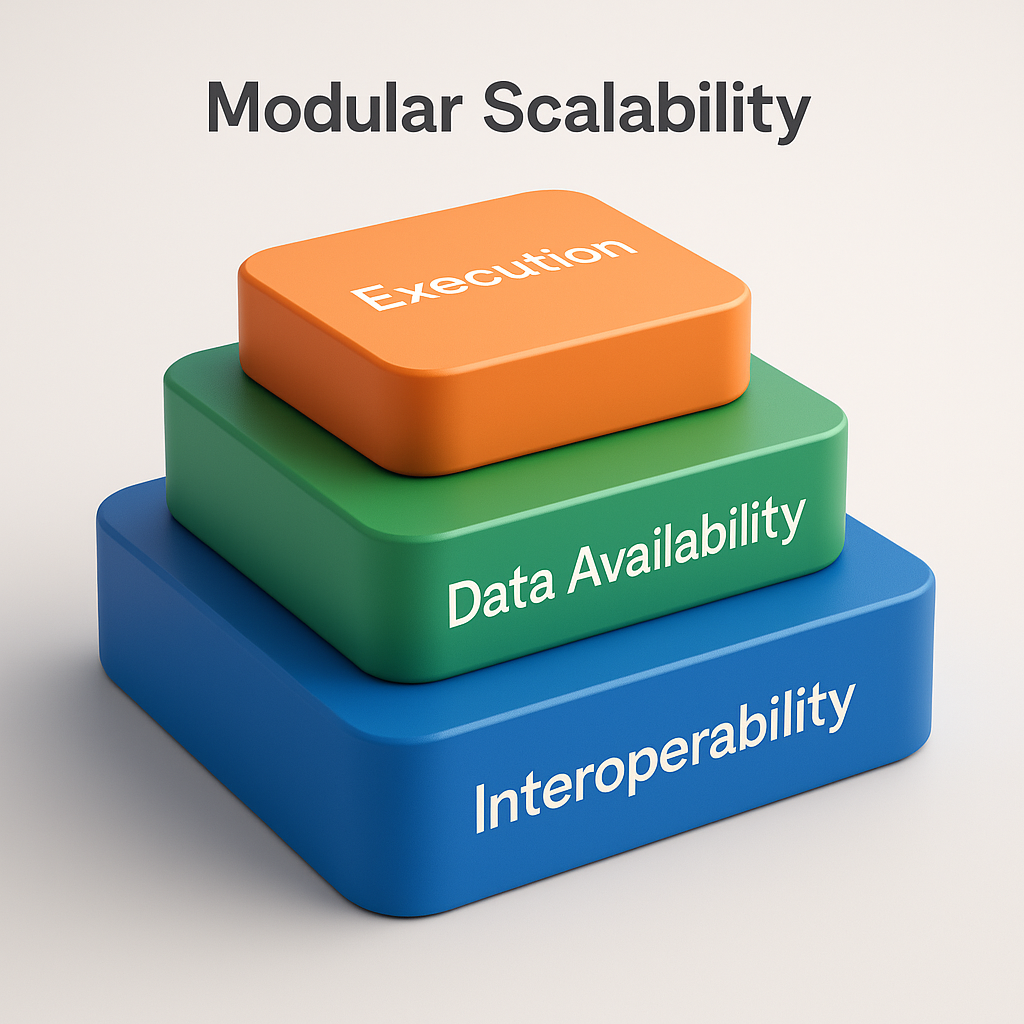
Xarva is architected as a modular Layer-1 system, with clear separation between core functions:
- Execution (XCVM)
- Data availability
- Interoperability
- Settlement and finality
This separation is intentional. In regulated environments, architectural coupling increases systemic risk. Xarva’s modular design acts as a risk containment mechanism, ensuring that issues in one layer do not compromise the integrity of the entire system.
For enterprises, this delivers:
- Predictable system behaviour under load
- Isolated fault domains
- Clear regulatory boundaries per function
- Modularity enables Xarva to scale throughput without compromising compliance guarantees.
3.4 Deterministic Identity and Jurisdiction Enforcement
Identity on Xarva is not optional, probabilistic, or externally inferred.
XCVM enforces identity and jurisdictional requirements as part of execution logic. Transactions are evaluated against predefined policy rules that determine whether an action is permitted within a given jurisdiction, counterparty relationship, or regulatory scope.
This enables:
- Jurisdiction-aware execution
- Automated policy enforcement
- Reduction of manual review and exception handling
Critically, identity and jurisdiction rules are verifiable and auditable, allowing enterprises to demonstrate compliance without exposing sensitive data.
3.5 Built-In Auditability and Regulatory Defensibility
Traditional systems rely on logs, reports, and reconciliations assembled after execution. These artefacts are often incomplete, inconsistent, or contested during audits.
Xarva embeds auditability directly into execution.
Each compliant transaction produces:
- A deterministic execution record
- A policy validation trace
- A time-stamped settlement outcome
These records form a native audit trail that is generated automatically and immutably. There is no need to reconstruct compliance history after the fact.
For regulators and auditors, this provides:
- Clear attribution of responsibility
- Verifiable enforcement of rules
- Reduced ambiguity during investigations
- For enterprises, it materially lowers audit cost and regulatory exposure.
3.6 Interoperability Without Compliance Leakage
Xarva is designed to interoperate with external systems and networks without exporting compliance risk.
Interoperability is handled through controlled interfaces that preserve:
- Identity enforcement
- Policy constraints
- Audit guarantees
This ensures that compliance does not degrade when interacting with external infrastructure. Xarva acts as the settlement authority, not a passive relay.
As a result, enterprises can integrate Xarva into existing workflows without compromising regulatory posture.
3.7 Architecture as an Adoption Enabler
Xarva’s architecture is not optimized for novelty or maximum throughput at any cost. It is optimized for enterprise adoption under regulatory scrutiny.
By enforcing compliance before execution, isolating risk through modular design, and generating auditability natively, Xarva allows enterprises to:
Automate regulated settlement
Scale across jurisdictions with confidence
Reduce operational and compliance overhead
Treat settlement as deterministic infrastructure
This architectural foundation enables everything that follows: Proof-of-Utility consensus, economic alignment, and enterprise-grade finality.
Section 4 — Proof-of-Utility (PoU) Consensus
4.1 Why Traditional Consensus Models Fail Regulated Settlement
Most blockchain consensus mechanisms were designed to optimise for openness and liveness, not regulated economic activity.
Proof-of-Work rewards computational expenditure without regard to economic usefulness.
Proof-of-Stake rewards capital concentration rather than real-world activity.
In both cases, validator incentives are detached from the quality, compliance, or economic relevance of the transactions being processed.
For regulated enterprises, this misalignment creates risk:
- Validators are rewarded even when no meaningful settlement occurs
- Network security is decoupled from real economic demand
- Speculative activity distorts infrastructure incentives
- Xarva addresses this structural flaw directly.
4.2 Proof-of-Utility: Aligning Consensus with Real Settlement
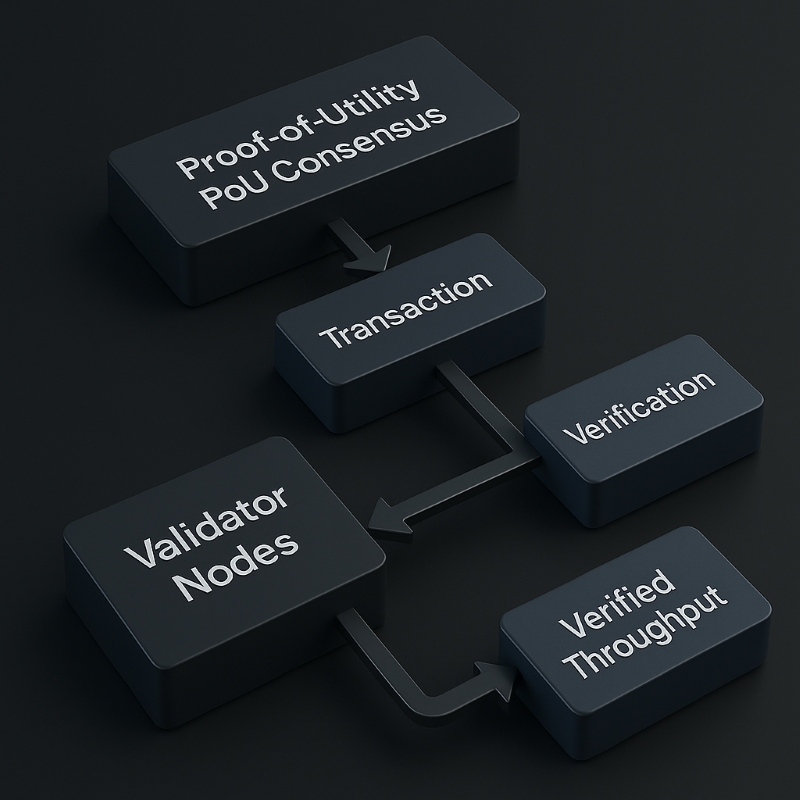
Proof-of-Utility (PoU) is Xarva’s consensus mechanism, purpose-built for enterprise settlement.
Under PoU, validators are rewarded based on verified economic utility, not raw computation or passive stake. Utility is defined as the successful processing and settlement of compliant, enterprise-grade transactions.
In simple terms:
Validators earn rewards by settling real obligations — not by consuming resources or locking capital alone.
This creates a direct alignment between:
- Network security
- Enterprise usage
- Validator incentives
- As settlement demand grows, validator participation scales naturally alongside it.
4.3 What Counts as “Utility” on Xarva
Utility on Xarva is not subjective or externally assessed. It is measured deterministically at protocol level.
Examples of utility include:
- Successful settlement of compliant enterprise transactions
- Correct execution of jurisdictionally constrained obligations
- Adherence to policy, identity, and audit requirements enforced by XCVM
- Non-compliant or invalid transactions generate zero utility, regardless of volume or attempted execution.
This ensures that:
- Spam and speculative activity are economically disincentivised
- Validators focus on correctness and compliance
- Network rewards track genuine economic value creation
4.4 Validator Selection and Incentive Structure

Validators on Xarva are not selected solely by stake size or computational capacity.
Under PoU, validator participation is governed by:
- Eligibility requirements
- Compliance correctness
- Verified settlement throughput
- Rewards are allocated based on the quality and quantity of utility delivered, rather than raw activity.
This design encourages:
- Operational excellence
- Accurate policy enforcement
- Long-term alignment with enterprise needs
- Validators that consistently deliver compliant settlement are economically favoured over those that merely participate.
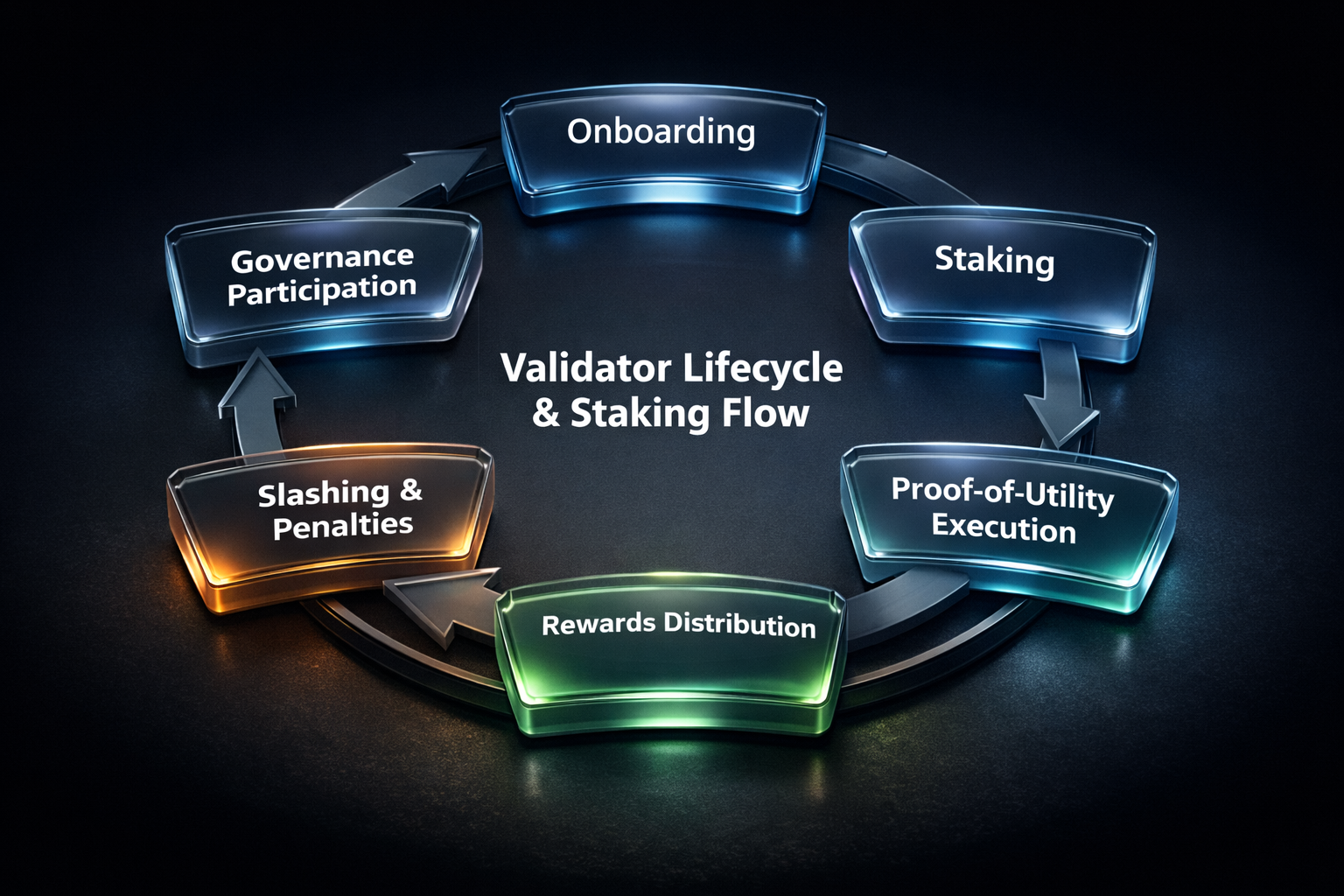
Illustrates the full validator lifecycle on Xarva, from onboarding and stake commitment through Proof-of-Utility execution, rewards distribution, slashing enforcement, and governance participation within a continuous, compliance-aligned loop.
4.5 Economic Feedback Loop Between Usage and Security
PoU creates a self-reinforcing feedback loop:
- Enterprises use Xarva to settle real obligations
- Settlement generates measurable utility
- Validators are rewarded for delivering that utility
- Network security increases in proportion to real demand
- This contrasts sharply with speculative networks where security often peaks during periods of low real usage.
For enterprises, this means:
- Security scales with adoption
- Infrastructure cost reflects real economic value
- Network incentives remain stable across market cycles
4.6 Regulatory and Enterprise Implications
PoU has material implications for regulatory defensibility.
Because validator rewards are tied to compliant settlement:
- Incentives encourage adherence to policy
- Non-compliant behaviour is economically penalised
- Auditability extends into consensus outcomes
- This makes Xarva suitable for environments where settlement infrastructure must withstand regulatory scrutiny, not just technical attack.
- For enterprises, PoU converts consensus from a technical abstraction into a measurable service layer aligned with business outcomes.
4.7 Proof-of-Utility as Infrastructure, Not Experimentation
PoU is not designed to maximise short-term token velocity or speculative participation.
It is designed to function as infrastructure:
- Predictable
- Economically grounded
- Governable
By aligning consensus rewards with real-world settlement, Xarva ensures that the network’s long-term viability is anchored in enterprise usage rather than transient market behaviour.
Section 5 — End-to-End Enterprise Settlement Pipeline
5.1 Why Settlement Pipelines Matter More Than Payments
In enterprise environments, value does not move in isolation. It moves as the result of obligations—contracts, usage records, SLAs, regulatory constraints, and jurisdictional rules.
Traditional payment systems treat settlement as a post-process:
- Obligations are defined off-chain
- Compliance is checked externally
- Reconciliation occurs after value has moved
- This separation creates latency, dispute risk, and operational overhead.
- Xarva inverts this model.
- Settlement on Xarva is not an afterthought. It is the primary execution path.
5.2 Overview of the Xarva Settlement Pipeline
The Xarva settlement pipeline enforces obligations before value moves, not after.
At a high level, the pipeline follows five deterministic stages:
- Intent Formation
- Pre-Execution Compliance Enforcement
- Obligation Validation and Encoding
- Atomic Execution and Settlement
- Finality and Audit Output
- Each stage is enforced natively by the protocol, ensuring no step can be bypassed or deferred.
5.3 Stage 1 — Intent Formation
Settlement begins with intent, not payment.
Intent encapsulates:
- The parties involved
- The economic obligation being settled
- Applicable jurisdictional and policy constraints
- Required audit and reporting parameters
- This ensures that settlement context is explicit and machine-verifiable from the outset.
- Unlike traditional systems, intent is not inferred post-facto—it is declared upfront.
5.4 Stage 2 — Pre-Execution Compliance Enforcement
Before any execution occurs, intent is evaluated within the Xarva Compliance Virtual Machine (XCVM).
XCVM deterministically enforces:
- Identity and permission constraints
- Jurisdictional applicability
- Policy and regulatory rules
- Contractual conditions
- If any condition fails, execution is halted before settlement.
This removes:
- Post-settlement compliance checks
- Manual intervention
- Regulatory ambiguity
- Compliance is no longer advisory—it is structural.
5.5 Stage 3 — Obligation Validation and Encoding
Once compliance is satisfied, the obligation itself is validated.
This includes:
- Verification of settlement terms
- Validation of economic parameters
- Encoding of obligation logic into execution-ready form
- At this stage, the obligation becomes a deterministic object that can be executed and audited identically across the network.
- There is no reliance on external reconciliation or subjective interpretation.
5.6 Stage 4 — Atomic Execution and Settlement
Execution and settlement occur atomically.
This means:
- Either the obligation settles in full
- Or nothing settles at all
- There are no partial settlements, delayed reconciliations, or asynchronous adjustments.
Atomicity ensures:
- Elimination of settlement risk
- Deterministic outcomes
- Immediate finality
For enterprises, this removes an entire class of operational and legal risk traditionally associated with cross-border and multi-party settlement.
5.7 Stage 5 — Finality and Audit Output
Upon successful settlement, Xarva produces:
- Cryptographically verifiable finality
- Deterministic audit artifacts
- Time-stamped execution records
- Audit output is generated as a byproduct of execution, not as an external reporting process.
This enables:
- Real-time auditability
- Regulator-ready records
- Elimination of manual reporting pipelines
- Settlement and audit converge into a single operation.
5.8 Integration with Proof-of-Utility (PoU)
The settlement pipeline is directly linked to Proof-of-Utility (PoU).
Validators are rewarded only when:
- Settlement completes successfully
- Compliance is enforced correctly
- Obligations are resolved deterministically
This ensures that validator incentives are aligned with:
- Enterprise-grade execution
- Policy correctness
- Operational reliability
- Settlement throughput directly translates into network security and economic sustainability.
5.9 Why This Pipeline Changes Enterprise Adoption Dynamics
By collapsing intent, compliance, execution, settlement, and audit into a single deterministic flow, Xarva delivers capabilities that existing rails cannot replicate.
Enterprises gain:
- Predictable settlement outcomes
- Reduced compliance overhead
- Elimination of reconciliation workflows
- Lower dispute and audit risk
- Xarva becomes not just a payment alternative, but settlement infrastructure.
5.10 Relationship to Token Economics and Governance
The settlement pipeline is the economic engine of the Xarva network.
All protocol fees originate here. All validator rewards depend on it. All token burns are driven by real usage.
This makes the pipeline foundational to:
- Section 6 (Tokenomics & Economic Flow)
- Section 7 (Governance and Risk Allocation)
- Without settlement, nothing else matters. With it, the entire network becomes self-reinforcing.
Section 6 — Tokenomics & Economic Flow (Burn / Reward / Treasury)
6.1 Tokenomics as Infrastructure, Not Incentive
Xarva’s token model is not designed to stimulate speculative activity or bootstrap artificial demand.
It exists to:
- Secure the network
- Align validator behaviour with enterprise utility
- Sustain protocol operations over decades
- The XRV token functions as economic infrastructure, not a financial abstraction.
Every unit of value flowing through the network is the result of real enterprise settlement activity, not inflationary rewards or subsidised usage. The economic flows described in this section derive directly from the settlement pipeline defined in Section 5 and are governed through the framework outlined in Section 7.
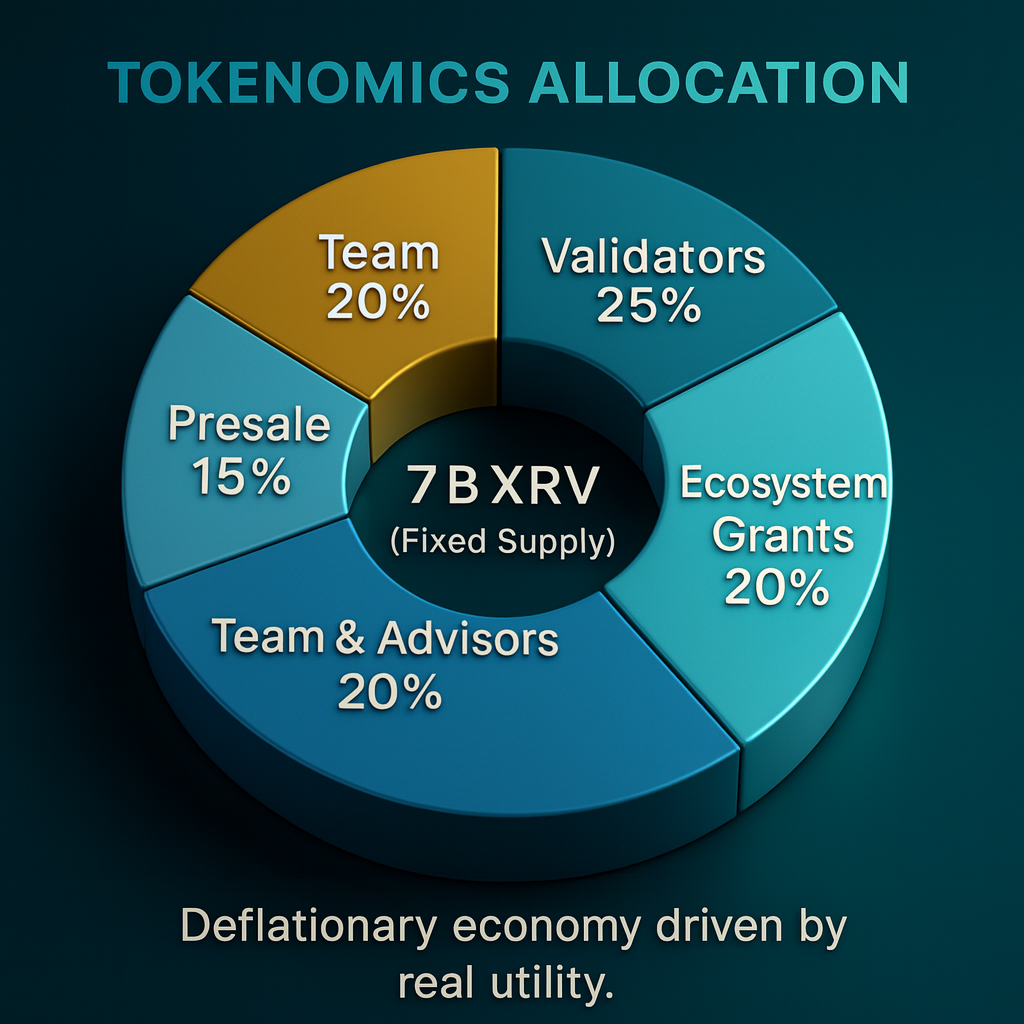
Xarva’s presale allocates 15% of the fixed 7 billion XRV supply (1.05 billion XRV) across six structured tranches: Seed, Private A, Private B, Strategic, Community, and Public.
The tranche design intentionally begins with smaller allocations and lower entry pricing, expanding progressively across later stages. This structure rewards early participants while maintaining disciplined price discovery and controlled supply introduction.
The presale represents the only issuance-based distribution of XRV. Following completion of the presale, all subsequent economic behaviour — including token burns, validator rewards, and treasury accumulation — is driven exclusively by real settlement activity on the network, not by inflation or discretionary issuance.
The tranche structure illustrated in Figure 4.3 defines the initial distribution of XRV into circulation. Subsequent economic behaviour — including burn, validator rewards, and treasury accumulation — is driven exclusively by real settlement activity, not issuance schedules.
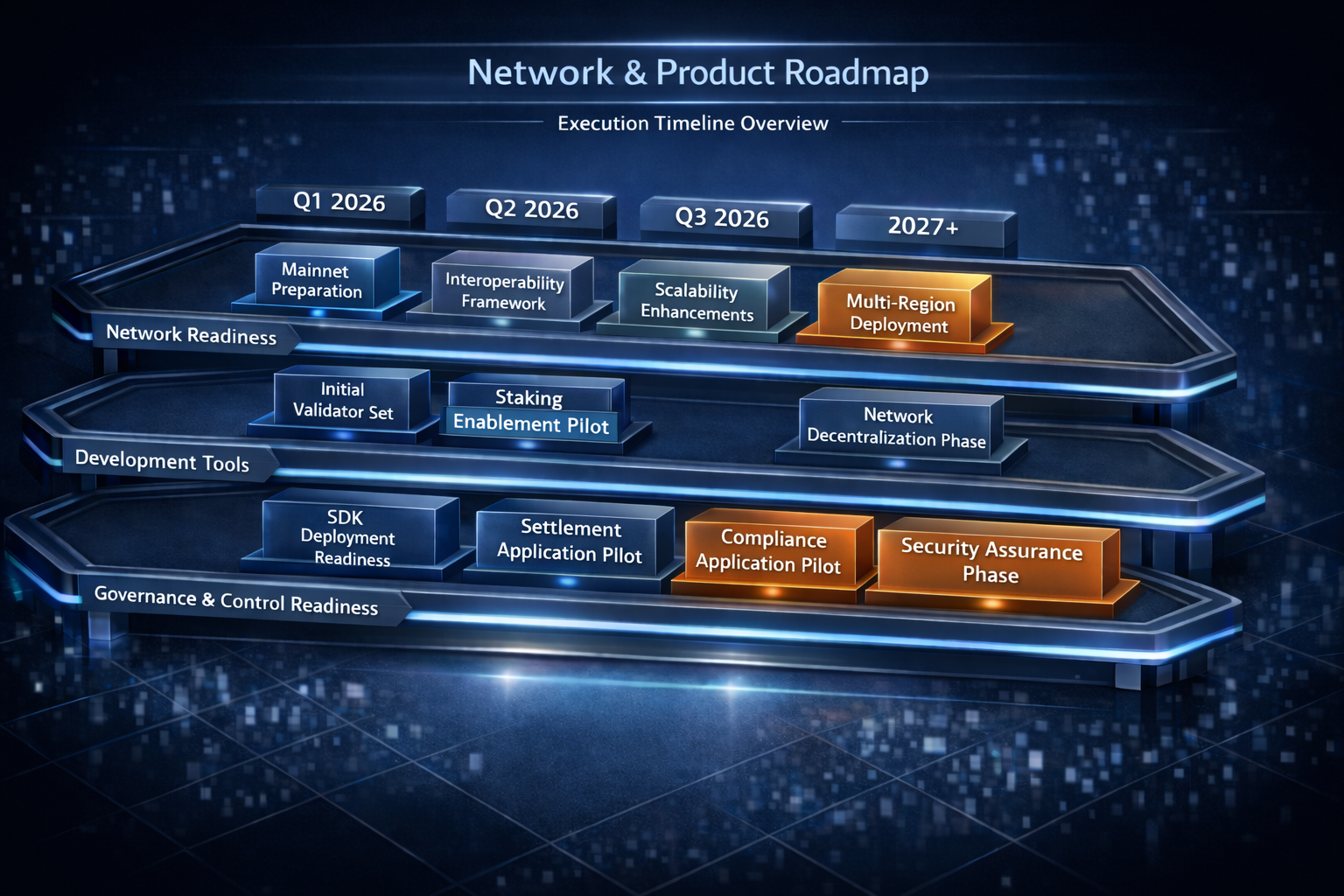
The targeted presale raise of approximately $350 million supports mainnet deployment, validator infrastructure, regulatory licensing, and planned liquidity provisioning ahead of network launch.
6.2 Economic Primitives of the Xarva Network

The Xarva economy is built on three deterministic primitives:
- Settlement Fees
- Validator Rewards
- Treasury Allocation
- All three are programmatically enforced at protocol level and originate from a single source: verified settlement throughput.
- There are no external revenue assumptions.
6.3 Source of Fees — Enterprise Settlement Activity

All protocol fees are generated when an enterprise obligation is settled via the Xarva pipeline (Section 5).
Fees are:
- Deterministically calculated
- Collected at execution time
- Inseparable from settlement finality
There are no:
- Transaction subsidies
- Artificial liquidity incentives
- Speculative issuance events
- If settlement does not occur, no value is created.
6.4 Fee Allocation Model — Burn / Reward / Treasury

Upon settlement, protocol fees are programmatically allocated across three destinations:
6.4.1 Burn Mechanism
A defined portion of fees is permanently removed from circulation.
This ensures:
- Supply contraction as usage increases
- Long-term alignment between adoption and scarcity
- Resistance to inflationary dilution
- Burns are usage-driven, not discretionary.
6.4.2 Validator Rewards (Proof-of-Utility)
Validator rewards are issued only when:
- Settlement completes successfully
- Compliance rules are enforced correctly
- Deterministic finality is achieved
- Rewards scale with utility delivered, not stake size alone.
This prevents:
- Idle capital dominance
- Speculative validator participation
- Security divorced from economic activity
- Proof-of-Utility directly ties network security to enterprise throughput.
6.4.3 Network Treasury
The remaining portion of fees is allocated to the protocol treasury.
Treasury funds are used exclusively for:
- Protocol upgrades
- Security hardening
- Ecosystem infrastructure
- Governance-approved initiatives
- Treasury growth reflects real economic demand, not issuance schedules.
6.5 Closed-Loop Economic Design
Xarva operates a closed-loop economic system:
- Enterprises generate settlement demand
- Demand produces protocol fees
- Fees fund validators and infrastructure
- Validators secure settlement capacity
- Increased capacity enables further enterprise adoption
- There are no external dependencies required to sustain this loop.
This distinguishes Xarva from networks that rely on:
- Continuous token issuance
- External liquidity incentives
- Short-term speculative cycles
6.6 Token Utility for Enterprises
Enterprises interact with XRV because it provides deterministic settlement guarantees, not because it is a tradable asset.
XRV enables:
- Access to compliance-native settlement
- Predictable fee structures
- Finality guarantees embedded at execution time
For enterprises, XRV is:
- A settlement instrument
- A compliance-enforced execution medium
- A mechanism to reduce operational and regulatory risk
- It replaces fragmented payment and reconciliation stacks with a single primitive.
6.7 Long-Term Supply Dynamics
XRV supply is fixed and non-inflationary.
Over time:
- Usage-driven burns reduce circulating supply
- Validator rewards shift from issuance to fee-based
- Treasury accumulation stabilises protocol funding
This creates:
- Structural scarcity tied to adoption
- Reduced reliance on token emissions
- Predictable long-term economics
- Token value becomes a reflection of enterprise settlement volume, not speculative velocity.
6.8 Governance Alignment
Economic flows are governed transparently and programmatically.
Changes to:
- Fee allocation ratios
- Treasury usage
- Burn parameters
Require governance approval, ensuring:
- Predictability for enterprises
- Accountability for token holders
- Long-term protocol integrity
- Governance is explored further in Section 7.
6.9 Why This Model Scales Institutionally
Xarva’s tokenomics are designed to scale with:
- Regulatory scrutiny
- Institutional capital
- Multi-industry adoption
- There are no assumptions that break under scale.
- The more the network is used, the more conservative and resilient its economics become.
Section 7 — Governance, Risk Allocation, and Control Framework
7.1 Governance as Infrastructure, Not Voting
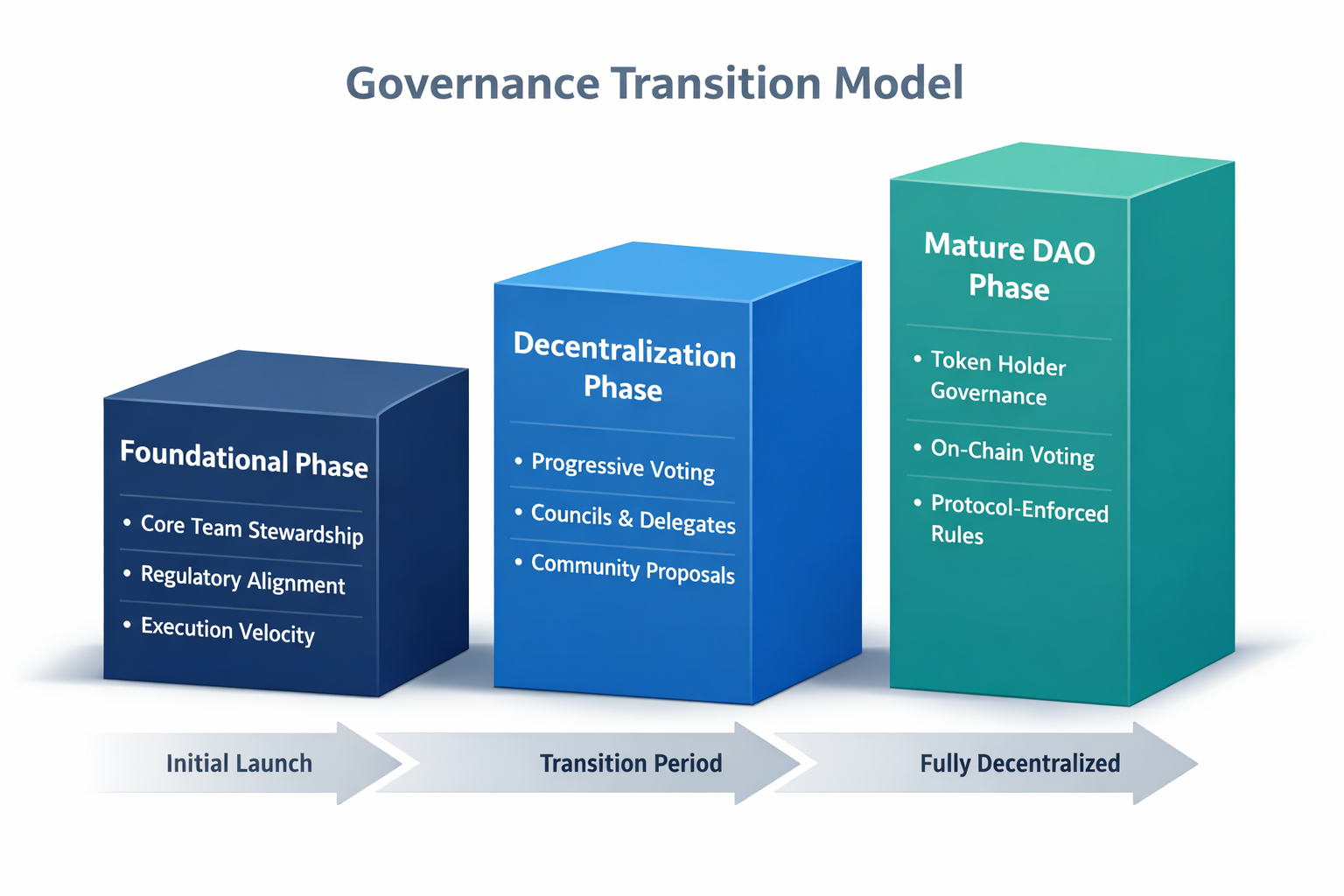
Xarva follows a phased governance transition model designed to balance execution efficiency, regulatory alignment, and long-term decentralization.
In the foundational phase, governance is exercised through core team stewardship to ensure protocol integrity, compliance readiness, and rapid execution during early network deployment.
As the network matures, governance transitions into a decentralization phase, introducing progressive voting mechanisms, delegated councils, and structured community proposals. This phase expands participation while preserving operational stability.
In the mature phase, governance responsibility is primarily exercised by token holders through on-chain voting and protocol-enforced rules. At this stage, governance processes are increasingly automated and transparent, with decisions executed deterministically by the protocol.
This phased approach ensures that decentralization is achieved responsibly, without compromising security, compliance obligations, or network reliability.
In regulated environments, governance cannot rely on informal coordination, discretionary decision-making, or token-weighted popularity. Enterprises, regulators, and counterparties require predictable authority, deterministic controls, and clearly assigned accountability.
Xarva treats governance as infrastructure, not as a social process.
Rather than focusing on who can vote, Xarva defines:
- What decisions exist
- When those decisions can occur
- Which entities are authorised to make them
- How decisions are enforced at execution time
This model ensures that governance outcomes are machine-enforceable, auditable, and resistant to capture. This governance model exists to preserve the determinism of settlement (Section 5) and the integrity of economic flows (Section 6) under regulatory scrutiny.
7.2 Separation of Governance Domains
Xarva explicitly separates governance into independent domains to prevent risk contagion:
Protocol Governance
Controls core protocol parameters, including:
- Consensus rules (Proof-of-Utility)
- XCVM execution constraints
- Settlement finality rules
- Fee routing logic
- These parameters are deliberately difficult to change and require multi-stage approval and time-delayed execution.
- Operational Governance
Covers day-to-day operational parameters such as:
- Validator onboarding thresholds
- Network capacity scaling
- Non-breaking configuration updates
- Operational governance is designed for stability and continuity, not experimentation.
- Economic Governance
Controls economic variables including:
- Burn / reward / treasury allocation ratios
- Validator reward weighting
- Incentive calibration based on real settlement demand
- Economic governance is constrained by hard-coded bounds to prevent inflationary or extractive behaviour.
- Compliance Governance
Defines jurisdictional, identity, and policy rules enforced by XCVM:
- Identity requirements
- Jurisdictional restrictions
- Regulatory policy logic
- Importantly, compliance rules are enforced before execution, not adjusted after the fact.
7.3 Deterministic Enforcement Through XCVM
Governance decisions in Xarva do not rely on off-chain enforcement or social compliance.
Once approved, governance changes are:
- Encoded into XCVM policy modules
- Versioned and timestamped
- Applied deterministically at execution time
This ensures that:
- No participant can selectively bypass governance
- All transactions are evaluated against the same rules
- Historical execution remains auditable against the rules active at that time
- This model eliminates ambiguity about which rules applied to which transactions.
7.4 Risk Allocation by Design
Traditional settlement systems distribute risk across multiple parties:
- Operations teams manage reconciliation
- Legal teams handle disputes
- Compliance teams validate after execution
- Finance teams absorb settlement failures
- Xarva collapses this fragmentation.
Risk is reallocated structurally as follows:
- Protocol risk is bounded by deterministic execution rules
- Compliance risk is enforced pre-execution
- Operational risk is reduced through atomic settlement
- Counterparty risk is minimised through obligation-aware settlement
By enforcing obligations, compliance, and settlement atomically, Xarva transforms risk from an operational problem into a protocol-level property.
7.5 Governance Safeguards and Failure Containment
Xarva incorporates multiple safeguards to prevent governance failure:
- Time-delayed execution for material changes
- Multi-party approval requirements for critical parameters
- Explicit separation between economic and compliance governance
- Rollback-resistant execution logic
These safeguards ensure that:
- Sudden parameter manipulation is not possible
- Governance capture cannot occur silently
- Enterprises have predictable change windows
- Governance actions are visible, auditable, and reviewable before activation.
7.6 Alignment with Enterprise and Regulatory Expectations
Xarva’s governance model aligns with how regulated systems are evaluated in practice:
- Clear authority boundaries
- Deterministic enforcement
- Immutable audit trails
- Pre-execution controls
- Explicit risk ownership
This allows enterprises to treat Xarva not as a speculative network, but as settlement infrastructure subject to internal risk, audit, and compliance review.
7.7 Relationship to Settlement and Tokenomics
Governance in Xarva directly underpins:
- Settlement guarantees (Section 5)
- Economic incentives and burn logic (Section 6)
- Validator accountability under Proof-of-Utility (Section 4)
Without deterministic governance, real-time settlement and sustainable token economics are not possible. Xarva integrates governance into execution so that incentives, compliance, and finality remain aligned at scale.
Section 7 Summary
Xarva replaces discretionary, social governance with deterministic, protocol-enforced control.
By treating governance as infrastructure, Xarva delivers:
- Predictable authority
- Enforceable compliance
- Clear risk allocation
- Enterprise-grade auditability
This governance model is a prerequisite for regulated, high-volume, multi-jurisdictional settlement — and a foundational pillar of Xarva’s institutional readiness.
.
Section 8 — Enterprise Adoption, Industry Use Cases, and Demand Formation
8.1 Adoption Is Driven by Settlement Failure, Not Technology Curiosity
Enterprises do not adopt new infrastructure because it is novel. They adopt it when existing systems create measurable risk, cost, or delay.
Across regulated industries, the problem is consistent:
- Obligations are complex
- Compliance is jurisdiction-dependent
- Settlement is delayed or uncertain
- Reconciliation is manual and expensive
- Disputes are resolved after execution, not before
- Xarva is adopted where settlement failure is material, not where payments are merely slow.
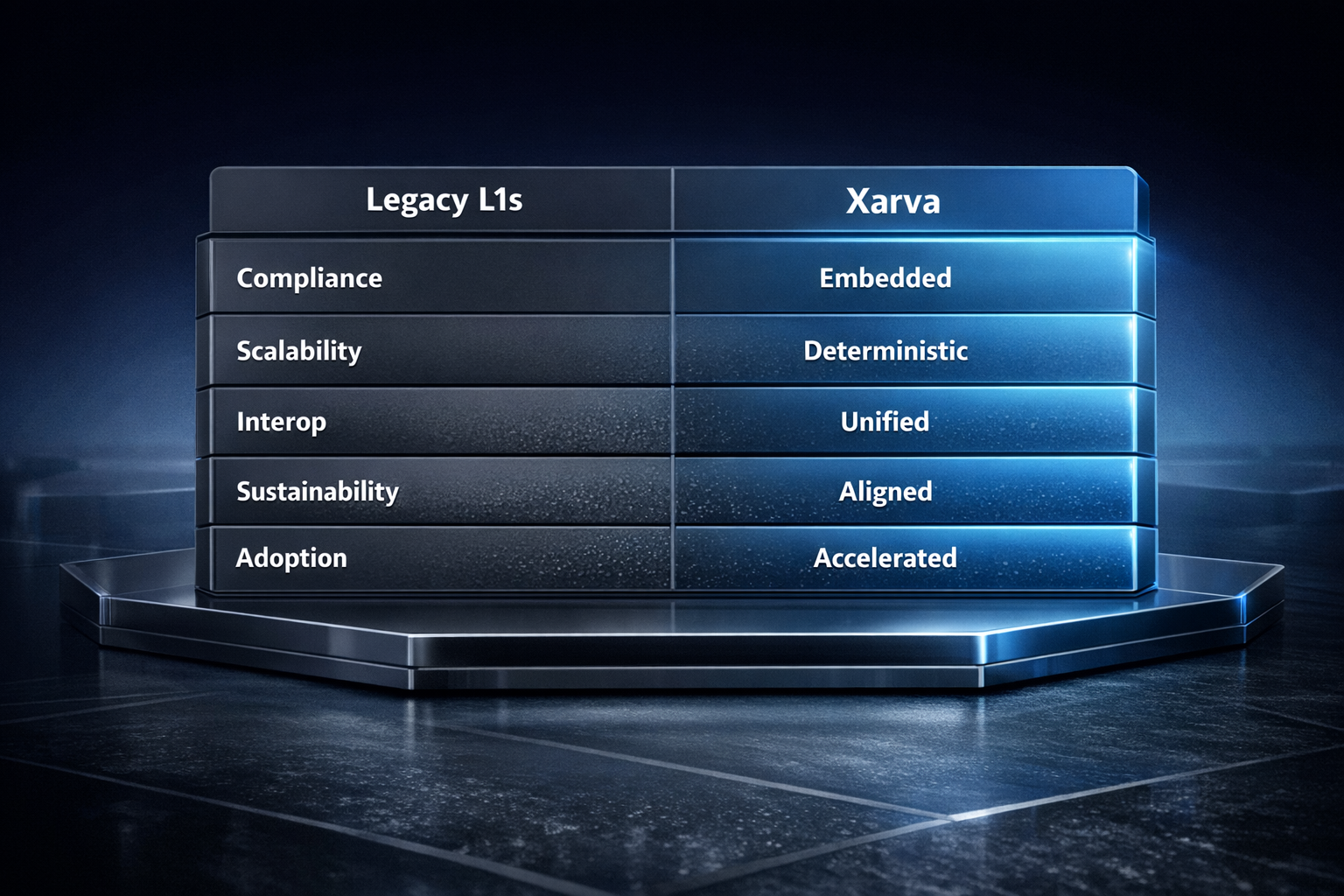
8.2 From Payments to Obligation-Centric Settlement
Traditional payment systems — including fiat rails and stablecoins — focus on moving value. They do not understand:
- Commercial obligations
- Jurisdictional constraints
- Policy conditions
- Usage-based billing
- SLA enforcement
As a result, enterprises must build large operational layers around payments to:
- Reconcile transactions to contracts
- Validate compliance after execution
- Manage disputes and chargebacks
- Prove audit trails retrospectively
Xarva replaces this model with obligation-aware settlement, where:
- Obligations are defined before execution
- Compliance is enforced pre-settlement
- Settlement finality resolves the obligation itself
- Audit artefacts are produced automatically
- This shift is the primary driver of enterprise adoption.
8.3 Industry-Specific Adoption Drivers
Telecommunications
Telecom operators face:
- Cross-border roaming settlements
- High-volume, usage-based billing
- Long reconciliation cycles
- Frequent disputes
Xarva enables:
- Real-time, usage-linked settlement
- Deterministic SLA enforcement
- Elimination of multi-week reconciliation
- Atomic settlement across jurisdictions
- Supply Chain and Logistics
Supply chains involve:
- Multi-party obligations
- Conditional payments
- Compliance with trade, customs, and ESG rules
Xarva allows:
- Settlement tied directly to delivery and verification events
- Jurisdiction-aware execution
- Reduced counterparty risk
- Transparent, auditable settlement records
- Carbon, Energy, and Environmental Markets
These markets require:
- Verified data inputs
- Jurisdiction-specific policy enforcement
- Audit-ready reporting
Xarva ensures:
- Compliance before settlement
- Deterministic accounting of credits and obligations
- Elimination of post-facto verification risk
- Healthcare and Regulated Data Flows
Healthcare systems require:
- Identity-bound transactions
- Strict policy enforcement
- Non-repudiable audit trails
Xarva provides:
- Identity-native execution
- Policy-aware settlement
- Deterministic auditability without exposing sensitive data
8.4 Why Enterprises Use XRV Instead of Fiat or Stablecoins
Enterprises do not adopt XRV as a speculative asset. They use it as settlement infrastructure fuel.
XRV is required because it:
- Enables deterministic execution within XCVM
- Funds validator verification and compliance enforcement
- Aligns economic incentives with real settlement activity
- Supports atomic burn, reward, and treasury flows
Unlike fiat or stablecoins:
- XRV is not merely transferred — it is consumed as part of settlement
- Fees reflect real compliance and execution work
- Economic activity maps directly to protocol demand
- This ensures that token demand is tied to enterprise usage, not financial speculation.
8.5 Incentives for Enterprises to Adopt Xarva
Enterprises gain measurable advantages by using Xarva:
- Reduced reconciliation and dispute costs
- Faster settlement finality
- Lower regulatory exposure
- Clear audit trails
- Predictable settlement outcomes
- These benefits compound with scale. As transaction volume increases, Xarva becomes more attractive relative to legacy rails, not less.
8.6 Adoption Flywheel and Network Effects
Xarva’s adoption model creates a positive feedback loop:
- Enterprises onboard to solve settlement risk
- Real usage generates protocol fees
- Fees reward validators and fund the treasury
- Token burn aligns long-term economics
- Network capacity and reliability increase
- Additional enterprises onboard
- This flywheel is grounded in real economic activity, not speculative incentives.
8.7 Enterprise Onboarding Without Vendor Lock-In
Xarva is designed to integrate with existing enterprise systems:
- No requirement to replace core ERP or billing systems
- Settlement logic operates as infrastructure beneath existing workflows
- No dependency on specific vendors or proprietary services
- This reduces friction and accelerates adoption while preserving enterprise autonomy.
- Section 8 Summary
- Xarva is adopted where settlement matters — not where payments are convenient.
By shifting from payment-centric rails to obligation-aware, compliance-native settlement, Xarva enables enterprises to:
- Reduce risk
- Lower operational cost
- Achieve deterministic finality
- Scale regulated activity with confidence
- Enterprise adoption is therefore not speculative. It is structural.
Section 9 — Risk, Security, and Failure Models
9.1 Enterprise Risk Is Settlement Risk
For enterprises, risk does not originate from volatility or market price movements. It originates from uncertain settlement.
The primary risks enterprises face today are:
- Obligations that settle late or incorrectly
- Disputes arising after execution
- Jurisdictional non-compliance discovered post-facto
- Incomplete or non-deterministic audit trails
- Fragmented accountability across systems and vendors
- Xarva is designed to eliminate these risks structurally, not operationally.
9.2 Structural Risk Reduction Through Pre-Execution Enforcement
Traditional systems rely on post-execution controls:
- Payments execute first
- Compliance checks follow
- Reconciliation corrects errors later
- Disputes are resolved manually
- Xarva inverts this model.
In Xarva:
- Obligations are validated before execution
- Identity and jurisdiction are enforced at protocol level
- Policy rules are evaluated deterministically
- Settlement occurs only if all constraints are satisfied
- This approach reduces the surface area for operational and compliance failure by design.
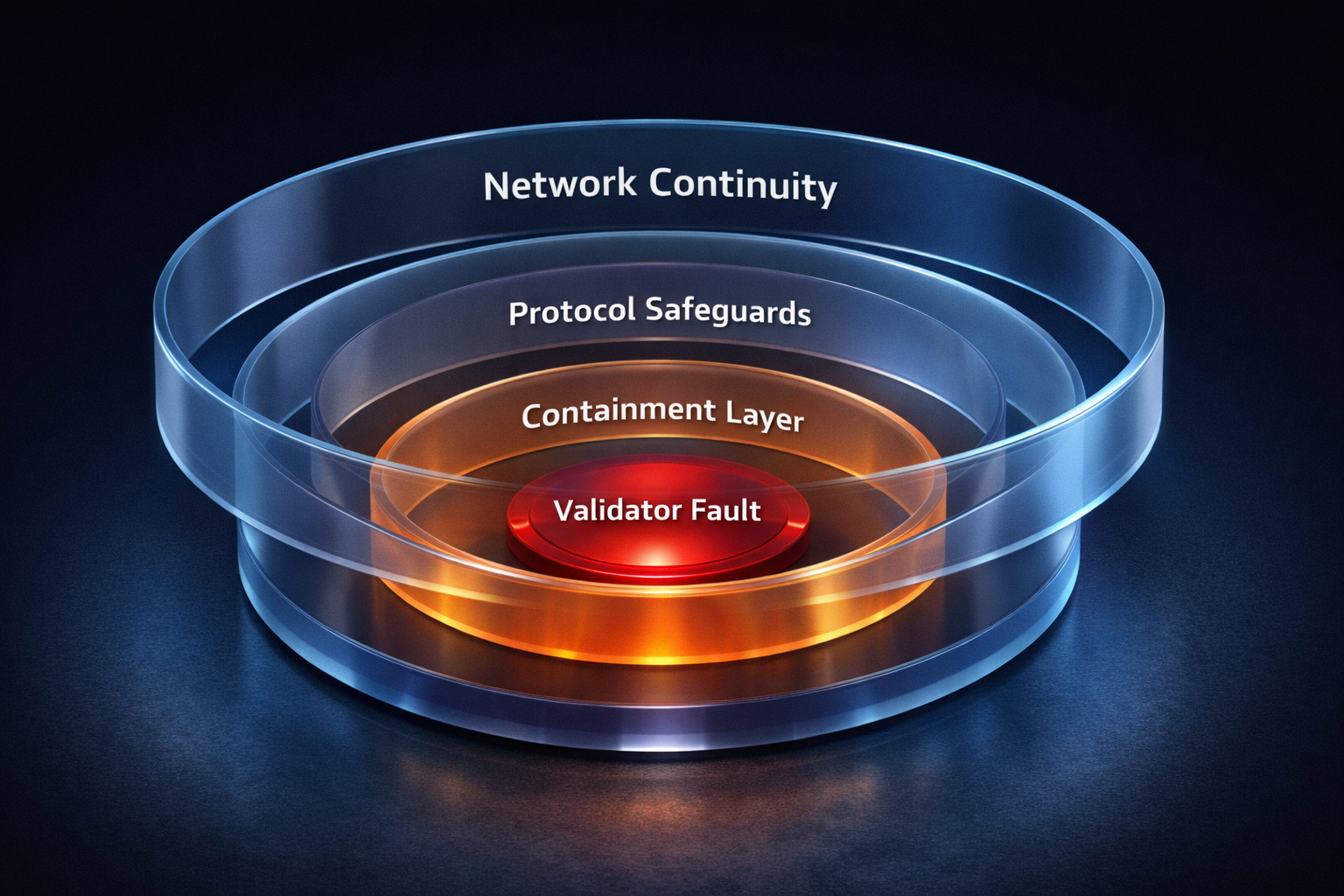
9.3 Failure Domains and Containment
Xarva is architected to isolate failure domains rather than allow cascading risk.
Execution Layer
Failures at execution level cannot bypass compliance checks. Invalid transactions are rejected deterministically before settlement.
Data Availability Layer
Data availability is modular and independent. Temporary DA degradation does not compromise execution correctness or auditability.
Validator Layer
Validators are economically and cryptographically constrained:
- Rewards depend on verified utility
- Incorrect execution reduces validator rewards
- Persistent misbehaviour results in economic penalties
- Application Layer
- Enterprise applications remain decoupled from settlement logic. Failures in upstream systems do not corrupt on-chain settlement state.
- This modular separation ensures that failures are contained, not propagated.
9.4 Security Model: Determinism Over Trust Assumptions
Xarva does not rely on trust in counterparties, operators, or intermediaries.
Security is achieved through:
- Deterministic execution
- Cryptographic verification
- Policy enforcement at protocol level
- Immutable audit trails
Every settlement outcome is:
- Verifiable
- Reproducible
- Jurisdiction-aware
- Non-repudiable
- This reduces reliance on contractual trust and human oversight.
9.5 Economic Security and Incentive Alignment
Xarva’s economic model directly supports network security.
Validators are rewarded for correct, compliant settlement
There is no incentive to inflate transaction volume artificially
Token burn aligns long-term network value with real usage
Treasury funding supports protocol maintenance and upgrades
This eliminates common blockchain failure modes where:
- Security depends on speculative transaction fees
- Validators are rewarded for volume rather than correctness
- Economic incentives diverge from enterprise needs
9.6 Regulatory and Compliance Risk Management
Xarva reduces regulatory risk by:
- Enforcing jurisdictional rules before execution
- Producing real-time, immutable audit artefacts
- Eliminating reliance on post-facto reconciliation
This enables enterprises to:
- Demonstrate compliance proactively
- Reduce regulatory reporting overhead
- Respond to audits with deterministic evidence rather than reconstructed records
- Importantly, Xarva does not replace regulatory frameworks — it operationalises them.
9.7 Operational Resilience and Continuity
Xarva is designed for long-lived enterprise infrastructure:
- No dependency on single vendors
- No reliance on off-chain discretionary controls
- Clear separation between protocol logic and enterprise applications
In the event of:
- Validator churn
- Network congestion
- External system outages
- Settlement correctness and auditability are preserved.
9.8 Failure Transparency and Auditability
When failures do occur — whether rejected transactions, policy violations, or execution errors — they are:
- Deterministic
- Logged immutably
- Attributable to specific rules or conditions
This transparency allows enterprises to:
- Diagnose issues quickly
- Resolve disputes without ambiguity
- Maintain accountability across stakeholders
- Section 9 Summary
- Xarva treats risk as a systems problem, not a governance afterthought.
By enforcing compliance, identity, and obligation logic before execution — and aligning economic incentives with correct settlement — Xarva delivers:
Lower operational risk
Reduced regulatory exposure
Deterministic outcomes
Enterprise-grade security without trust assumptions
Section 10 — Network Evolution, Scalability, and Long-Term Viability
10.1 Infrastructure Built for Decades, Not Cycles
Enterprise settlement infrastructure must outlive:
- Technology cycles
- Regulatory changes
- Market volatility
- Vendor churn
- Xarva is architected as foundational settlement infrastructure, not a product iteration or application platform.
Design priorities reflect this mandate:
- Deterministic behaviour over feature velocity
- Backward compatibility over experimental upgrades
- Governance-led evolution rather than unilateral changes
- This positions Xarva as long-term digital infrastructure rather than a transient blockchain network.
10.2 Modular Scalability Without Compromising Determinism
Xarva scales horizontally without weakening its security or compliance guarantees.
Key principles:
- Execution, data availability, interoperability, and settlement remain modular
- Increased throughput does not change execution semantics
- Policy enforcement remains constant regardless of scale
Unlike systems that rely on sharding or optimistic execution models that introduce probabilistic outcomes, Xarva preserves deterministic finality at all scales.
This is essential for regulated enterprises where:
- “Eventually consistent” is not acceptable
- Settlement outcomes must be identical across jurisdictions and audit contexts
10.3 Controlled Upgrade Path and Protocol Stability
Protocol evolution in Xarva is deliberate and governed.
Upgrades:
- Are proposed transparently
- Undergo impact analysis across compliance, execution, and economic layers
- Preserve historical auditability and rule enforcement
- There is no concept of “breaking changes” that retroactively alter obligations or settlement outcomes.
This ensures:
- Enterprise systems remain compatible over long time horizons
- Regulatory expectations are not invalidated by protocol updates
- Settlement history remains immutable and defensible
10.4 Economic Sustainability and Network Funding
Long-term viability requires predictable funding mechanisms.
Xarva’s economic design ensures:
- Network revenue originates from real enterprise settlement usage
- Protocol fees fund validator operations and core infrastructure
- Treasury resources support maintenance, security research, and upgrades
This avoids reliance on:
- Inflationary token issuance
- Speculative transaction demand
- External subsidies
- The result is a self-sustaining network aligned with enterprise usage growth.
10.5 Institutional Adoption Flywheel
As enterprises onboard:
- Settlement volume increases
- Validator utility increases
- Token burn increases
- Network resilience strengthens
This creates a reinforcing loop where:
- Adoption strengthens economics
- Economics strengthen security
- Security strengthens regulatory confidence
- Confidence accelerates adoption
- Crucially, this flywheel is driven by usage, not speculation.
10.6 Interoperability Without Compromising Compliance
Xarva is designed to interoperate with:
- Existing enterprise systems
- External networks
- Industry-specific infrastructure
- However, interoperability does not dilute compliance.
All inbound and outbound interactions remain subject to:
- Identity validation
- Jurisdictional policy enforcement
- Deterministic audit generation
- This allows Xarva to function as a settlement backbone, rather than an isolated ecosystem.
10.7 Governance-Led Evolution
Long-term infrastructure requires accountable governance.
Xarva’s governance model:
- Separates operational execution from policy oversight
- Enables controlled protocol evolution
- Aligns stakeholder incentives around network integrity
This prevents:
- Fragmentation
- Unilateral changes
- Governance capture by short-term interests
- The result is institutional-grade continuity.
10.8 Designed for Regulatory Maturity
Xarva assumes that regulation will increase, not decrease.
The protocol is designed to:
- Absorb new regulatory requirements
- Encode jurisdictional changes without redesign
- Support evolving audit standards
- This makes Xarva future-resilient in regulated industries where compliance obligations expand over time.
- Section 10 Summary
- Xarva is not optimised for speed alone, nor for speculative growth.
It is optimised for:
- Longevity
- Determinism
- Compliance
- Economic sustainability
- Institutional trust
By combining modular scalability, controlled evolution, and usage-driven economics, Xarva positions itself as permanent settlement infrastructure for regulated global commerce.
Section 11 — Enterprise Adoption & Industry Onboarding (Polish Pass)
11.1 Why Enterprises Adopt Xarva
Enterprises do not adopt blockchains for experimentation or ideology. They adopt infrastructure when it reduces operational risk, lowers compliance cost, and produces regulator-defensible outcomes.
Xarva is adopted because it turns settlement into a deterministic process.
On Xarva:
- Every transaction is policy-validated before execution
- Settlement finality is predictable and time-bound
- Compliance outcomes are provable on-chain
- Audit evidence is generated as part of normal operation
This contrasts sharply with existing approaches, where compliance is external, reconciliation is manual, and settlement risk persists for days or weeks.
Xarva removes uncertainty from settlement. That certainty is the product.
11.2 Enterprise Decision Framework
When enterprises evaluate settlement infrastructure, four questions dominate:
- Who is allowed to transact?
- Under what rules and jurisdictions?
- How quickly does value settle, and is finality reversible?
- Can this be proven to regulators and auditors without bespoke work?
- Xarva answers all four at the protocol layer.
Identity verification, jurisdictional policy, sanctions screening, and audit logging are enforced by the XCVM and validated by the network. Enterprises do not integrate compliance tooling around Xarva — they inherit it by using the chain.
This is explored technically in Section 3 (Technical Architecture) and operationally in Section 5 (End-to-End Settlement Pipeline).
11.3 Why Not Fiat Rails
Traditional fiat settlement systems were not designed for real-time, cross-border enterprise flows.
Limitations include:
- Multi-day settlement cycles (T+2 to T+30)
- Layered intermediaries and correspondent banks
- Fragmented compliance responsibilities
- Manual reconciliation and dispute handling
- These systems externalize risk to enterprises while charging for the privilege.
Xarva collapses settlement, compliance validation, and auditability into a single atomic process. Funds settle in minutes, not days, and the compliance state of the transaction is final at execution — not inferred later.
For enterprises operating across borders, this is not an optimization. It is a structural upgrade.
11.4 Why Not Stablecoins Alone
Stablecoins reduce volatility, but they do not solve enterprise settlement.
They lack:
- Native policy enforcement
- Deterministic compliance guarantees
- Protocol-level audit trails
- Governance over rule changes
In practice, enterprises using stablecoins still rely on off-chain compliance checks, custodians, and reconciliation systems. Settlement may be faster, but risk is simply relocated, not removed.
Xarva treats stable assets as instruments, not infrastructure. When used on Xarva, they operate inside a compliance-enforced execution environment with provable controls and finality guarantees.
The value is not the asset. The value is the system enforcing its use.
11.5 Why Not Internal Reconciliation Systems
Large enterprises often attempt to solve settlement internally through bespoke ledgers, netting arrangements, or bilateral agreements.
These approaches:
- Do not scale beyond trusted counterparties
- Require ongoing legal and operational overhead
- Break down under multi-jurisdictional scrutiny
- Create opaque risk pools that regulators distrust
Xarva replaces bespoke reconciliation with a shared, neutral settlement layer where rules are explicit, enforced, and visible to permitted observers.
This reduces bilateral complexity while preserving enterprise control through policy configuration and governance.
11.6 Industry Onboarding Pathways
Xarva is designed for phased, low-risk adoption.
Typical onboarding follows a consistent pattern:
- Isolated Pilot A single settlement flow (e.g. inter-carrier invoice, device usage clearing) is moved on-chain with limited counterparties.
- Policy Binding Jurisdictional rules, identity thresholds, and audit requirements are codified via XCVM policies.
- Parallel Run Xarva operates alongside existing systems, producing auditable equivalence.
- Primary Settlement Xarva becomes the system of record for that flow.
- Expansion Additional counterparties, regions, or use cases are added without re-architecting.
- This pathway minimizes disruption while allowing enterprises to internalize operational confidence before scaling.
11.7 Sector Applicability (Non-Exhaustive)
While telecom is the initial focus, the adoption logic generalizes:
- Telecom: Interconnect billing, roaming settlement, usage clearing
- IoT: Device-level metering, automated micro-settlement
- Supply Chain: Milestone-based escrow and conditional release
- Carbon: Verified issuance, transfer, and retirement
- Healthcare: Cross-provider reconciliation with audit guarantees
- Government: Grant disbursement, inter-agency settlement, compliance reporting
- Each sector benefits from the same core property: settlement that is provably compliant at the moment it occurs.
11.8 The Role of XRV in Enterprise Adoption
XRV is not a speculative instrument. It is required network infrastructure.
XRV is used to:
- Pay protocol fees
- Incentivize validators through Proof-of-Utility
- Secure network governance
- Anchor economic finality
Enterprises do not need to hold XRV for investment purposes. They interact with the network because it guarantees outcomes they cannot reliably achieve elsewhere.
As settlement volume grows, demand for blockspace and validation grows. XRV demand follows utility, not narrative.
This economic flow is detailed in Section 6 (Tokenomics & Economic Flow) and mathematically defined in Appendix B.
11.9 Enterprise Confidence Loop
Xarva creates a reinforcing adoption cycle:
- Enterprises transact because settlement is deterministic
- Deterministic settlement attracts real volume
- Real volume strengthens validator incentives via PoU
- Strong incentives improve performance and reliability
- Improved reliability increases enterprise confidence
- This loop aligns enterprise users, validators, and governance without relying on inflation or speculative subsidies.
11.10 Closing Position
Enterprises adopt Xarva for one reason:
- It makes settlement boring — predictable, auditable, and compliant.
- In regulated industries, boring is trust. Trust is adoption. Adoption is utility.
Xarva is not competing for attention. It is positioning itself as infrastructure that disappears into normal business operations — exactly where enterprise systems belong.
Forward reference: This adoption logic underpins the governance and risk controls described in Section 7, the competitive analysis in Section 8, and the investor protections outlined in Section 9.
Section 12 — Why Xarva Is Infrastructure, Not a Payment Rail
12.1 The Category Error in “Blockchain Payments”
Most blockchain projects are framed as payment systems. This framing is incorrect for regulated enterprise activity.
Payments move value. Infrastructure enforces obligations.
Enterprises do not fail because value cannot be transferred quickly. They fail because obligations settle incorrectly, incompletely, or without regulatory certainty.
Xarva is designed to resolve that failure mode.
12.2 Payment Rails Transfer Value After Risk Is Assumed
Traditional payment rails — including fiat systems and stablecoins — operate after risk has already been taken.
They assume that:
- Parties are authorised
- Obligations are valid
- Compliance checks were performed correctly
- Disputes can be resolved later
- Settlement is treated as confirmation, not enforcement.
- This model is acceptable for consumer payments. It is insufficient for regulated, high-volume, multi-party enterprise activity.
12.3 Xarva Enforces Obligations Before Value Moves
Xarva inverts this structure.
On Xarva:
- Identity is validated before execution
- Jurisdictional policy is enforced before settlement
- Obligations are resolved atomically
- Audit artefacts are produced at execution time
- Value does not move unless the obligation itself is valid, compliant, and final.
- This is the defining property of infrastructure.
12.4 Why This Distinction Matters Institutionally
Institutions evaluate systems differently depending on category.
Payment systems are assessed on:
- Speed
- Cost
- Liquidity
Infrastructure systems are assessed on:
- Determinism
- Auditability
- Risk containment
- Regulatory defensibility
- Longevity
- Xarva is designed to meet the second set of criteria.
This is why Xarva can be adopted without replacing enterprise payment stacks. It operates beneath them, resolving settlement and compliance risk at the infrastructure layer.
12.5 XRV as Infrastructure Fuel, Not a Payment Token
XRV is not a medium of exchange in the traditional sense.
It functions as:
- A settlement execution fee
- A validator incentive mechanism
- A governance and security anchor
- An economic finality primitive
- Enterprises do not “pay with” XRV. They consume network capacity secured by XRV.
This mirrors how infrastructure is funded elsewhere:
- Fuel powers engines
- Spectrum powers networks
- Compute credits power cloud platforms
- XRV powers deterministic settlement.
12.6 Infrastructure That Disappears into Normal Operations
The success condition for Xarva is not visibility. It is invisibility.
When operating correctly:
- Settlement occurs without dispute
- Compliance is provable without reconstruction
- Audits rely on deterministic records
- Reconciliation teams shrink instead of scale
- Xarva disappears into enterprise workflows — exactly where infrastructure belongs.
12.7 Closing Position
Xarva is not competing with payment rails. It is replacing the weakest layer beneath them.
By enforcing compliance, identity, and obligation logic before execution, Xarva transforms settlement from an operational risk into a deterministic system property.
That is why Xarva is infrastructure. And why it is adopted where payments are not enough.
Appendices
Appendix A — Technical Architecture Deep Dive (XCVM, DA, Consensus)
This appendix provides a deeper technical explanation of Xarva’s core architectural components for technical reviewers, regulators, and due-diligence teams.
It expands on concepts introduced in Sections 3 (Architecture & Compliance Enforcement), 4 (Proof-of-Utility Consensus), and 5 (Settlement Pipeline), without introducing new mechanisms or dependencies.
A.1 Architectural Objective
Xarva’s architecture is designed to satisfy three non-negotiable requirements for regulated enterprise settlement:
- Deterministic execution
- Pre-execution compliance enforcement
- Protocol-level auditability
- All architectural decisions flow from these requirements.
- Performance, modularity, and interoperability are treated as secondary constraints, never at the expense of determinism or compliance.
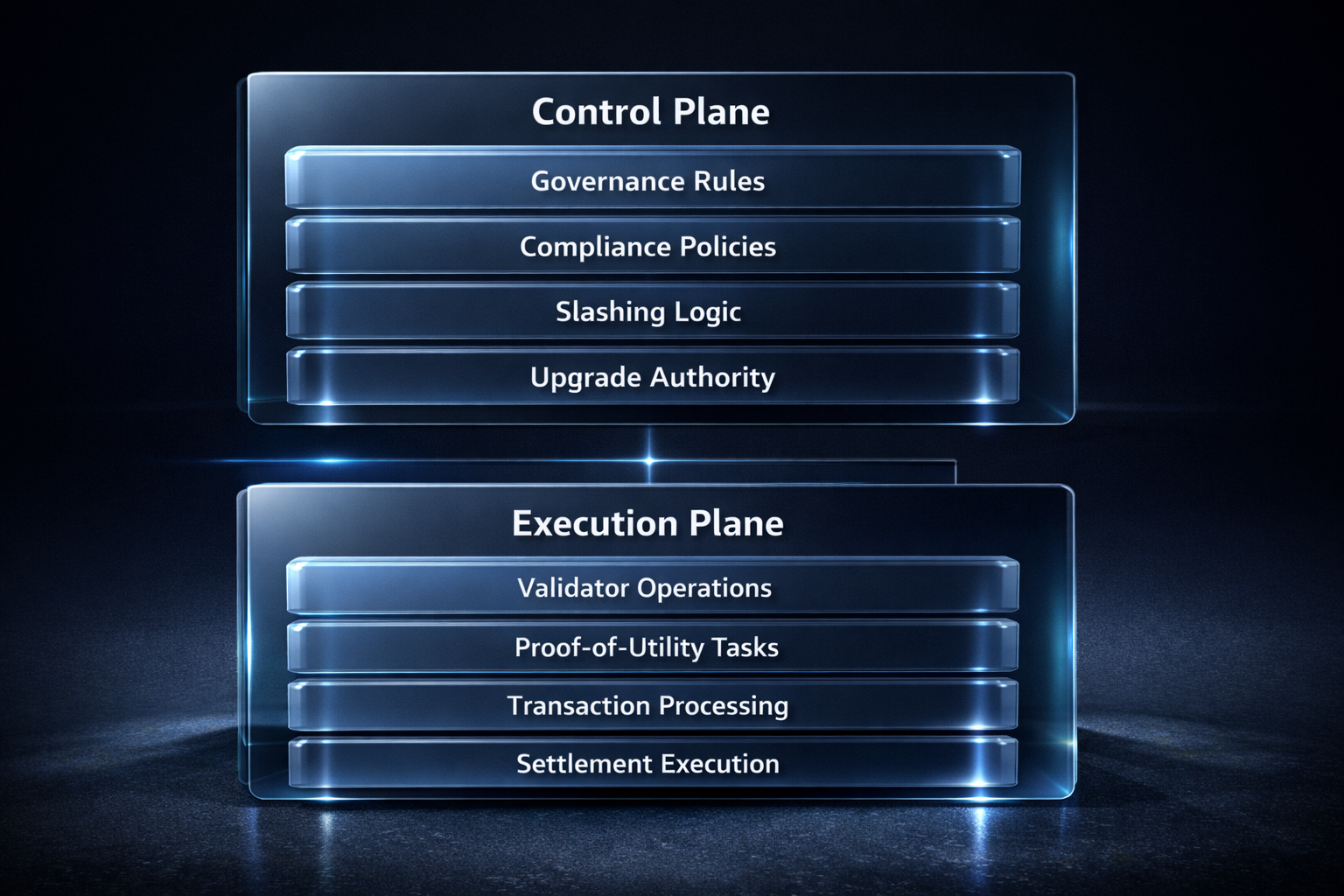
A.2 High-Level Architectural Separation
Xarva is implemented as a modular Layer-1 system with explicit separation between the following domains:
- Execution (XCVM)
- Consensus (Proof-of-Utility)
- Data Availability
- Settlement and Finality
- This separation is intentional and functions as a risk-containment mechanism.
No layer is permitted to:
- Bypass compliance enforcement
- Infer policy outcomes
- Alter execution semantics independently
- Each layer has a bounded responsibility and a clearly defined interface.
A.3 Xarva Compliance Virtual Machine (XCVM)
A.3.1 Purpose of XCVM
XCVM is the execution environment responsible for enforcing:
- Identity eligibility
- Jurisdictional constraints
- Obligation validity
- Policy conformance
- Audit trace generation
- XCVM is compliance-native by design. It is not a general-purpose virtual machine with compliance added later.
A.3.2 XCVM Execution Lifecycle
Every transaction submitted to Xarva passes through the same deterministic lifecycle:
- Intent Intake Transaction intent is declared explicitly, including parties, obligation type, and required policy context.
- Policy Evaluation XCVM evaluates intent against active policy constraints, including identity, jurisdiction, and obligation rules.
- Obligation Validation Economic and contractual parameters are validated for correctness and completeness.
- Execution Eligibility Decision
- If any constraint fails → execution is rejected
- If all constraints pass → execution proceeds
- Deterministic Execution Execution occurs identically across all validators.
- Audit Artefact Generation Execution produces immutable audit artefacts as part of normal operation.
- At no point can execution occur before policy evaluation.
A.3.3 Determinism Guarantees
XCVM guarantees deterministic outcomes by enforcing:
- Fixed execution ordering
- Explicit policy inputs
- Versioned rule evaluation
- Elimination of non-deterministic external calls
- Given identical inputs and policy state, XCVM will always produce identical results.
This property is critical for:
- Regulatory defensibility
- Dispute resolution
- Cross-validator verification
A.4 Proof-of-Utility (PoU) and Execution Correctness
A.4.1 Role of Consensus
Consensus in Xarva is not responsible for deciding what should be allowed. That responsibility belongs to XCVM.
Consensus is responsible for:
- Agreeing on valid execution outcomes
- Finalising compliant state transitions
- Allocating rewards based on verified utility
A.4.2 Utility Measurement
Under Proof-of-Utility:
- Utility is generated only by compliant, successfully settled obligations
- Failed or rejected executions generate zero utility
- Speculative or spam activity is economically neutral or negative
Validators are therefore incentivised to:
- Enforce policies correctly
- Reject invalid transactions
- Prioritise execution correctness over volume
A.4.3 Validator Interaction with XCVM
Validators do not interpret policy discretionarily.
They:
- Execute XCVM deterministically
- Verify execution correctness
- Reach consensus on resulting state
- Any divergence in execution results in invalidation.
This ensures that:
- Compliance enforcement is uniform
- Execution correctness is economically enforced
- Settlement finality reflects verified compliance
A.5 Data Availability (DA)
A.5.1 Role of Data Availability
Data Availability ensures that:
- Execution inputs
- Policy evaluation context
- Settlement outcomes
- Audit artefacts
- remain accessible for verification and audit.
- DA is not responsible for execution or compliance logic.
A.5.2 DA and Auditability
Auditability in Xarva depends on two properties:
- Deterministic execution records (produced by XCVM)
- Accessible execution data (guaranteed by DA)
Together, these ensure that any settlement outcome can be independently verified after execution without reliance on discretionary logs or off-chain reconstruction.
A.6 Settlement and Finality
A.6.1 Atomic Settlement Model
Settlement in Xarva is atomic:
- Either the obligation settles fully
- Or no settlement occurs
- There is no partial settlement, delayed reconciliation, or retroactive adjustment.
This eliminates:
- Settlement ambiguity
- Multi-stage dispute resolution
- Operational rollback procedures
A.6.2 Finality Guarantees
Finality in Xarva means:
- Settlement outcomes are irreversible
- Audit artefacts are immutable
- Execution rules applied are provable
Once finality is reached, outcomes are authoritative for:
- Enterprises
- Counterparties
- Auditors
- Regulators
A.7 Failure Handling and Rejection Semantics
Xarva treats failure deterministically.
Invalid intent → rejected pre-execution
Policy violation → rejected pre-execution
Execution error → no state transition
Validator disagreement → consensus failure, not settlement
Failures are:
- Explicit
- Logged immutably
- Attributable to specific constraints
- This prevents silent failure modes common in off-chain reconciliation systems.
A.8 Interoperability Boundaries
Interoperability in Xarva is deliberately constrained.
External interactions:
- Must pass through XCVM
- Are subject to the same policy enforcement
- Cannot bypass compliance guarantees
- Xarva does not act as a passive relay. It remains the settlement authority.
A.9 Architectural Invariants
The following properties are invariant across Xarva’s architecture:
- Compliance precedes execution
- Execution is deterministic
- Settlement is atomic
- Audit artefacts are native
- Incentives align with correctness
- No future optimisation or extension may violate these invariants.
A.10 Appendix A Summary
This appendix demonstrates that Xarva’s architecture:
- Enforces compliance at execution time
- Produces deterministic, auditable outcomes
- Aligns consensus incentives with real settlement utility
- Contains failure and compliance risk structurally
- Scales without weakening regulatory guarantees
Xarva’s architecture is therefore suitable for long-lived, regulated settlement infrastructure rather than experimental or speculative deployment.
Appendix B — Regulatory Alignment & Compliance Model
This appendix describes how Xarva aligns with regulatory expectations for regulated settlement infrastructure at the architectural and protocol level, without reliance on external compliance tooling or jurisdiction-specific implementations.
This appendix is informational only and does not constitute legal or regulatory advice.
B.1 Design Principle: Compliance as a Precondition, Not a Process
Traditional financial and blockchain systems treat compliance as a process layer:
- Executed before settlement (manual checks), or
- Audited after settlement (reports, reconciliations, attestations)
- This approach creates ambiguity, delayed enforcement, and dispute risk.
Xarva is designed around a different principle:
Compliance is a precondition for execution, not a post-execution process.
On Xarva, settlement cannot occur unless compliance conditions are satisfied before execution. This shifts compliance from an operational activity to a deterministic system property.
B.2 Compliance Enforcement at Protocol Level
Xarva enforces compliance through the Xarva Compliance Virtual Machine (XCVM), which evaluates every transaction against predefined policy constraints prior to execution.
These constraints may include, but are not limited to:
- Identity eligibility
- Jurisdictional applicability
- Obligation validity
- Policy and rule conformance
- Audit and reporting requirements
- Transactions that fail compliance evaluation do not execute and therefore do not settle.
This ensures that:
- Non-compliant settlement outcomes cannot occur
- Compliance enforcement is uniform and reproducible
- Settlement records are regulator-defensible by construction
B.3 Identity and Jurisdiction as Deterministic Inputs
Xarva treats identity and jurisdiction as deterministic inputs to execution, not inferred metadata.
Key properties:
- Identity requirements are enforced prior to execution
- Jurisdictional rules are encoded as policy constraints
- Execution outcomes are conditional on these constraints
This allows the network to:
- Prevent prohibited transactions by design
- Enforce jurisdiction-specific constraints without fragmenting the protocol
- Produce auditable evidence of rule application
Importantly, Xarva does not assert universal identity models or regulatory equivalence across jurisdictions. Policy logic is abstracted to allow jurisdiction-specific enforcement without altering execution semantics.
B.4 Auditability and Evidence Generation
Xarva generates audit artefacts at execution time, not as reconstructed logs.
Each compliant settlement produces:
- A deterministic execution record
- A policy validation trace
- A time-stamped settlement outcome
These artefacts are:
- Cryptographically verifiable
- Immutable once generated
- Attributable to the rules in force at execution time
This enables:
- Real-time auditability
- Reduced reliance on post-facto reconciliation
- Clear attribution of compliance responsibility
- Audit artefacts are produced automatically as part of normal settlement and do not require discretionary reporting processes.
B.5 Separation of Compliance, Governance, and Operations
Xarva explicitly separates:
- Compliance enforcement (policy rules evaluated by XCVM)
- Governance authority (who can define or update rules)
- Operational execution (validators enforcing protocol logic)
This separation ensures that:
- Compliance rules cannot be bypassed operationally
- Governance changes are auditable and time-bounded
- Historical settlements remain verifiable under the rules that applied at the time
- This model aligns with regulatory expectations around control separation, change management, and audit traceability.
B.6 Risk Reduction Through Deterministic Controls
Xarva reduces regulatory and operational risk by eliminating classes of failure common in traditional systems:
Risk is addressed structurally rather than procedurally.
B.7 What Xarva Does Not Do
To avoid ambiguity, it is important to state explicitly what Xarva does not claim:
- Xarva does not grant regulatory approval
- Xarva does not replace legal, regulatory, or supervisory authorities
- Xarva does not guarantee compliance in the absence of correct policy configuration
- Xarva does not override jurisdictional requirements
- Xarva provides infrastructure capabilities that allow regulated entities to enforce, demonstrate, and audit compliance deterministically.
B.8 Regulatory Posture and Adaptability
Xarva is designed with the assumption that regulatory requirements will:
- Increase in complexity
- Expand across jurisdictions
- Require stronger auditability over time
The protocol architecture allows:
- New policy constraints to be encoded without re-architecting settlement logic
- Jurisdiction-specific rules to coexist without network fragmentation
- Historical execution to remain auditable under prior rulesets
- This makes Xarva suitable for long-lived, regulated infrastructure deployment.
B.9 Alignment Summary
Xarva aligns with regulatory expectations by:
- Enforcing compliance before execution
- Treating identity and jurisdiction as execution constraints
- Producing deterministic audit artefacts
- Separating governance, compliance, and operations
- Reducing reliance on discretionary controls
The result is settlement infrastructure that is defensible, auditable, and predictable under regulatory scrutiny — without introducing vendor dependency or opaque enforcement mechanisms.
Appendix C — Economic & Token Supply Mechanics
This appendix describes the economic mechanics of the Xarva network, including token supply constraints, fee flows, validator incentives, and treasury allocation.
It is intended for technical, regulatory, and due-diligence review and does not constitute financial, investment, or legal advice.
C.1 Economic Design Objective
Xarva’s economic model is designed to support regulated, long-lived settlement infrastructure, not short-term speculative activity.
Accordingly, the model prioritises:
- Deterministic fee generation
- Usage-linked incentives
- Fixed and bounded token supply
- Elimination of inflation dependency
- Alignment between enterprise settlement and network security
- All economic flows originate from verified settlement activity, not issuance schedules or artificial incentives.
C.2 Token Supply Characteristics
C.2.1 Fixed Supply
The total supply of XRV is fixed and non-inflationary.
No mechanism exists for:
- Ongoing emissions
- Discretionary minting
- Supply expansion through governance
This ensures that:
- Token supply is predictable
- Long-term dilution risk is eliminated
- Economic modelling remains bounded
C.2.2 Circulating Supply Dynamics
Circulating supply may change over time due to:
- Usage-driven token burns
- Validator rewards sourced from fees
- Treasury-controlled distributions approved via governance
No supply change occurs without:
- Deterministic on-chain rules, or
- Explicit governance-approved actions
C.3 Source of Economic Value
All economic value within the Xarva network originates from enterprise settlement execution.
Specifically:
- Fees are generated only when obligations settle successfully
- Failed, rejected, or non-compliant transactions generate no fees
- Speculative or artificial activity does not produce economic output
- If settlement does not occur, no value is created.
C.4 Settlement Fee Generation
Settlement fees are:
- Calculated deterministically at execution time
- Paid as part of settlement finality
- Inseparable from compliance enforcement
Fees compensate the network for:
- Compliance evaluation
- Execution verification
- Consensus finality
- Audit artefact generation
There are no:
- Fee subsidies
- Promotional discounts
- External incentive pools
C.5 Fee Allocation Model
Upon successful settlement, protocol fees are programmatically allocated across three destinations:
C.5.1 Burn Mechanism
A defined portion of each settlement fee is permanently removed from circulation.
This ensures:
- Supply contraction as usage increases
- Long-term alignment between adoption and scarcity
- Resistance to inflationary pressure
Burns are:
- Automatic
- Usage-driven
- Non-discretionary
C.5.2 Validator Rewards (Proof-of-Utility)
A portion of fees is allocated to validators that:
- Correctly enforce compliance
- Execute obligations deterministically
- Contribute to settlement finality
Validator rewards:
- Scale with verified utility
- Do not depend on passive capital alone
- Are unavailable for failed or rejected transactions
This prevents:
- Volume-only incentive abuse
- Idle capital dominance
- Security decoupled from real activity
C.5.3 Network Treasury
The remaining portion of fees is allocated to the network treasury.
Treasury funds may be used only for:
- Protocol maintenance and upgrades
- Security research and hardening
- Infrastructure support approved by governance
Treasury usage:
- Is transparent
- Is governed
- Reflects real economic demand
C.6 Closed-Loop Economic System
Xarva operates as a closed economic loop:
- Enterprises settle obligations
- Settlement generates protocol fees
- Fees fund validators and infrastructure
- Validators secure settlement capacity
- Increased capacity supports further adoption
- No external capital injection is required to sustain this loop.
This distinguishes Xarva from systems dependent on:
- Continuous token issuance
- Speculative fee activity
- External liquidity incentives
C.7 Proof-of-Utility and Economic Integrity
Proof-of-Utility (PoU) ensures that:
- Economic rewards correspond to real settlement activity
- Non-compliant execution is economically penalised
- Network security scales with enterprise usage
Economic integrity is therefore enforced at both:
- Execution level (XCVM), and
- Incentive level (PoU)
This dual enforcement prevents divergence between:
- Economic incentives
- Compliance correctness
- Settlement reliability
C.8 What the Economic Model Does Not Do
For clarity and risk containment, Xarva’s economic model does not:
- Promise returns or yields
- Provide price support mechanisms
- Include reflexive mint-and-reward loops
- Depend on speculative transaction volume
- Subsidise usage through inflation
- Token value, if any, is a by-product of utility, not a design objective.
C.9 Long-Term Economic Equilibrium
Over time, Xarva’s economics tend toward equilibrium:
- Validator rewards transition from issuance-heavy to fee-backed
- Burn mechanisms counterbalance circulation growth
- Treasury funding stabilises protocol operations
- Network security reflects real settlement demand
- This creates a conservative economic posture suitable for regulated infrastructure rather than financial experimentation.
C.10 Appendix C Summary
This appendix demonstrates that Xarva’s economic model is:
- Fixed in supply
- Usage-driven in value creation
- Non-inflationary by design
- Resistant to extractive dynamics
- Aligned with enterprise settlement activity
Xarva’s token economics therefore function as infrastructure economics, supporting deterministic, regulated settlement rather than speculative markets.
Appendix D — Glossary & Acronyms
Atomic Settlement
A settlement process in which execution and finality occur as a single, indivisible operation, such that obligations either settle completely or do not settle at all.
Audit Artefact
A cryptographically verifiable record generated deterministically at execution time, used to demonstrate compliance, settlement correctness, and policy enforcement.
Compliance-Native
A system design in which regulatory, identity, jurisdictional, and policy requirements are enforced at protocol level before execution, rather than applied post-facto or externally.
Consensus
The protocol-level mechanism by which network participants agree on valid state transitions and settlement outcomes.
Data Availability (DA)
The property that ensures transaction data required for verification, audit, and dispute resolution remains accessible and verifiable over time.
Deterministic Execution
Execution in which identical inputs, policies, and state always produce identical outcomes, independent of validator or environment.
Enterprise Settlement
The resolution of contractual, usage-based, or policy-bound obligations between regulated entities, resulting in legally and operationally final outcomes.
Finality
The point at which a settlement outcome is irreversible, non-repudiable, and accepted as authoritative by all network participants.
Governance
The structured, protocol-enforced process by which network parameters, policies, and economic rules are defined, modified, and applied.
Infrastructure
Foundational systems that enforce rules, provide deterministic outcomes, and operate independently of individual applications or market narratives.
Interoperability
The controlled ability of the Xarva network to interact with external systems or networks without exporting compliance risk or weakening enforcement guarantees.
Jurisdictional Policy
Rules that determine whether a transaction or obligation is permitted based on applicable legal, geographic, or regulatory constraints.
Obligation
A defined economic, contractual, or policy-bound requirement that must be satisfied for settlement to occur.
Policy Enforcement
The deterministic application of identity, jurisdictional, contractual, and regulatory rules prior to execution and settlement.
Proof-of-Utility (PoU)
Xarva’s consensus mechanism that rewards validators based on verified, compliant settlement activity rather than computational expenditure or passive capital.
Regulatory Defensibility
The ability to demonstrate, through deterministic records and protocol behaviour, that settlement outcomes comply with applicable regulatory expectations.
Risk Containment
Architectural separation that limits the propagation of failure or non-compliance across system components.
Settlement
The authoritative resolution of an obligation, resulting in final transfer of value and completion of associated compliance conditions.
Settlement Pipeline
The deterministic sequence of stages through which intent, compliance enforcement, execution, settlement, and audit generation occur.
Stable Asset
A digital asset designed to maintain price stability relative to a reference value, without providing compliance enforcement or settlement guarantees by itself.
Tokenomics
The protocol-defined economic rules governing token supply, fee generation, reward allocation, and treasury management.
Utility
Verified, compliant economic activity processed by the network that contributes to settlement finality and validator rewards.
Validator
A network participant authorised to verify execution correctness, enforce protocol rules, and contribute to settlement finality.
Xarva
A compliance-native, enterprise-grade Layer-1 settlement network designed for deterministic, regulated, real-time settlement.
Xarva Compliance Virtual Machine (XCVM)
The execution environment that enforces identity, jurisdictional policy, obligation validation, and auditability prior to transaction execution.
XRV
The native protocol token used to pay settlement fees, incentivise validators, secure governance, and anchor economic finality on the Xarva network.